Hummers Heading South

Within the past two weeks the population of Ruby-throated Hummingbirds (Archilochus colubris) here at my feeders, has dropped considerably. I had been putting out two quarts of syrup each day. Now I put out one cup each day. Big drop.

They’re packing their bags. Heading south. Migrating for the winter to Central America and Mexico. And it has been discovered that the Ruby-throated Hummingbird’s winter location is expanding further north to include the Gulf Coast states up the Atlantic Coast to South Carolina.

Ruby-throated Hummingbirds generally live to be between 3 and 5 years old. They learn to recognize the people that feed them, sometimes letting them know if the feeder is empty or needs fresh syrup.

As the Ruby-throated Hummingbirds migrate from north to south and back again they fly alone. They’re solitary birds. Often they’ll return to the same feeders, the same location where they were hatched. I sure will look forward to having them return to their summer home here in the mountains next spring.

Where Are My Bears?

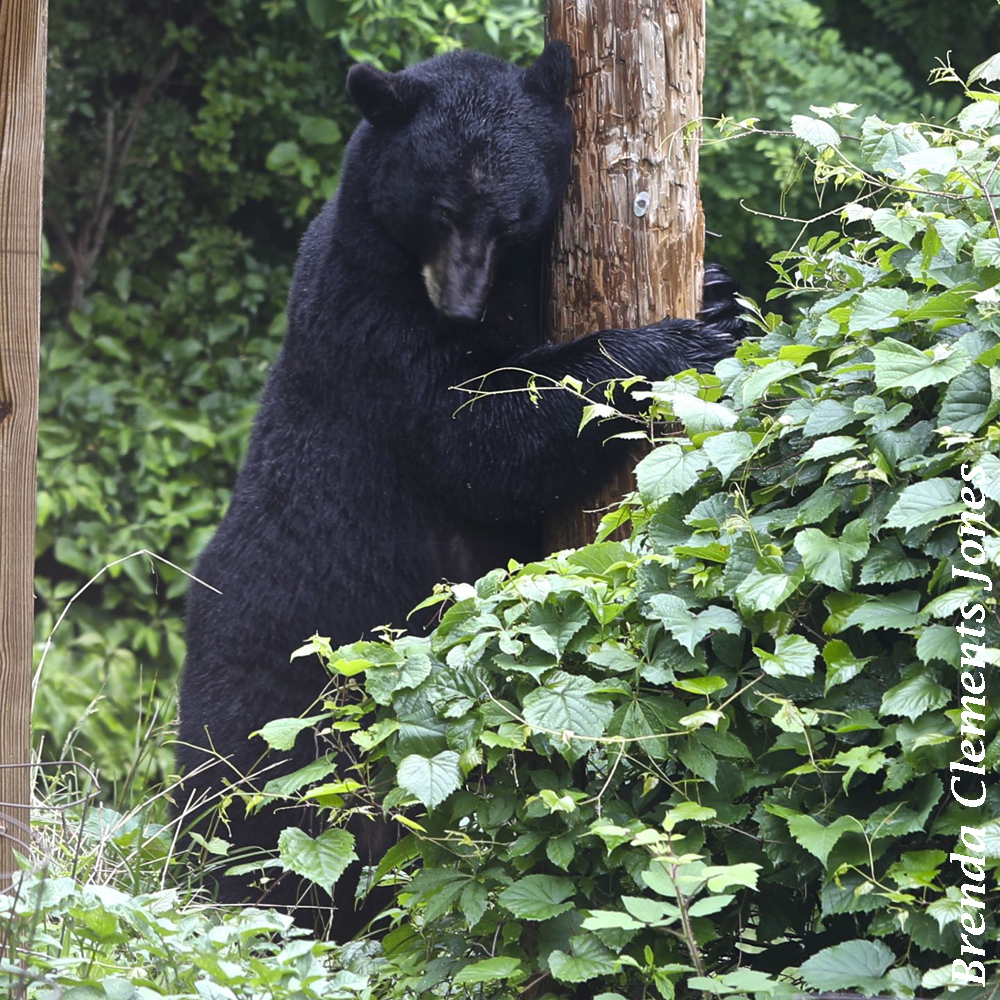
Labor Day Weekend is just days away. Considered by many to be the end of summer. But there has been something lacking in my summer here in the mountains. Bears.

They arrive all set to eat all the apples out of the apple tree or the all the cherries out of the cherry tree. Breaking branches as they climb. I quickly get a few photos then chase them away. Waving my arms wildly and screaming at them. We have a thing going. They go away till the next time.

Early this spring a bear did show up. A dear, pathetic bear, badly suffering with sarcoptic mange. He looked miserable. Skin and bones, very little fur. I called wildlife officials and reported the sighting and was asked to call again if the bear returned. It did not return.

Since then there have been no bears. Extremely unusual. They always come into the yard and climb the apple tree, and the cherry tree.

I have mixed feelings about their arrival. They shouldn’t be here in the yard. Near humans. I always make them realize that they are not welcome. They have all the rest of the mountain to roam. But they always return. I get my photos and chase them away. Again and again. But not this year.

I assume the lack of bears is due to this mange. It causes hair loss, emaciation, loss of vision, and death. I see very little about the mange and black bears in the news. Just a slight mention here or there. Nothing to indicate my lack of bears. Just my assumption. I miss my bears. I hope I’m wrong about the mange.

Juniper Hairstreak Revisited

Juniper Hairstreak (Callophrys gryneus) is native to most of North America. Once thought to be two separate species, residents of eastern North America and western North America are now considered to be just one species.

As butterflies, adult Juniper Hairstreaks seek the nectar of many flowers such as Queen Anne’s Lace, Winter Cress, Common Milkweed, Butterfly Weed, White Sweetclover and many more. Here in the Blue Ridge Mountains, males looking for females hang out on Eastern Red Cedars, their host plant in this area. Want to find some Juniper Hairstreaks? Try shaking some branches of ERCs. You might just shake some free. Eggs are laid on the tips of the leaves the Eastern Red Cedar. After emerging from their eggs, the caterpillars will eat the leaves.

Juniper Hairstreaks are little butterflies, generally measuring in with a wingspan of 1 to 1.25 inches. The above photo might help you visualize the size with a Carpenter Bee in the image. Yes, a good bit of brown, and tiny but not to be confused with a moth!

The PawPaw Patch

PawPaw (Asimina triloba). An understory small tree or large bush. Native to eastern North America. There are patches of them here and there up here in the mountains. And for a few years I had three or four individual PawPaw trees growing in my yard. Ones that I had planted. I was thoroughly enjoying them. One had even bloomed for me. Then came the clippers. Not intentional clippers but they clipped nonetheless. All the PawPaw trees got cut down. Ack!

Since then I’ve planted three new, tiny, PawPaw trees. Two have survived. But I’ve had a surprise. Where the clippers did their accidental thing, where the trees were cut down, they are coming up again, from root suckers that under normal circumstances form colonies or thickets. 

The reason for my fascination with PawPaws? They’re the host plant of one of my favorite butterflies, the Zebra Swallowtail (Eurytides marcellus). Plant them and these butterflies will come.

And all is well in the PawPaw Patch.

_______________________________________________________________________

If you would like to receive my daily blog posts by email, sign up here!

Skinks

Juvenile Skinks enjoy scampering up and down the cedar siding, and running back and forth across the porches of my cabin as they look for their next meal. It’s like having my own personal pest control company on duty! They eat insects, spiders and other invertebrates. As youngsters, my Skinks sport a cool looking shiny tail of a marvelous blue color that can be detached if the Skink is caught by a predator. AND the tail will continue to wiggle as the Skink escapes, frightening, diverting the attention of, or at least entertaining the predator. AND most of the time the Skink is able to grow a new tail. This one is either a Common Five-lined Skink (Plestiodon fasciatus) or a Broad-headed Skink (Plestiodon laticeps). At this young stage these two species are nearly indistinguishable. Whichever it is, I love having them around.

Northern Pearly-eye Joins the Chat

A couple days ago as I stood outside the yoga studio chatting with my dear teacher Kumud, a Northern Pearly-eye (Enodia anthedon) came by to join in the conversation, landing on me. I must keep in mind what it had to say. So profound. This friendly creature, this butterfly, has a wingspan of two inches. And is colored with many shades of brown. But it is butterfly not a moth.

Here’s a closeup of its antennae. A good way to tell the difference – butterfly or moth. This is what a butterfly antenna is like. A simple “wire” with a club-like top. A moth has a feathery antennae if it is male. A female moth has antennae that are saw-toothed. Butterflies can be tiny and brown. Moths can be large and marvelously colored. Pay attention to those antennae.

White and Red Dogwood Berries

Autumn is approaching. The leaves of some Flowering Dogwoods are getting richer, more and more red. Their crimson berries, or drupes, are in abundance. This is the species of Dogwood that most people think of when “Dogwood” is mentioned.

Flowering Dogwood (Cornus florida) and Gray Dogwood (Cornus racemosa). Two different Dogwood species. One of seventeen species native to North America. Like most Dogwood species, these two have opposite leaves as well as leaves with visible veins that curve parallel to the smooth edges.

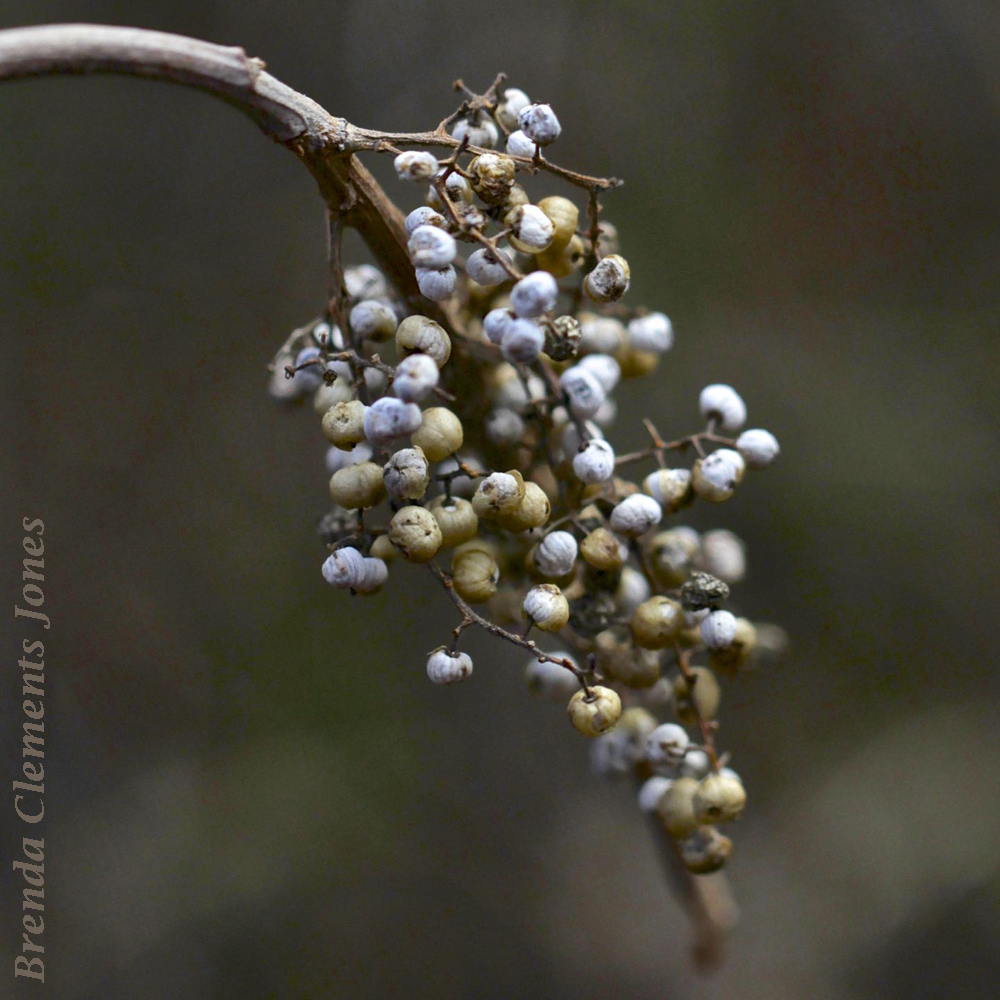
Gray Dogwood’s creamy white berries are plentiful now too, much to the pleasure of Cardinals, Flickers, Downy Woodpeckers, Bluebirds and many other songbirds.

Flowering Dogwoods grow as single trees. Gray Dogwoods form colonies, by growing suckers and spreading. These dense colonies create a perfect space for nesting songbirds. Glad to see these berries. Autumn is approaching!