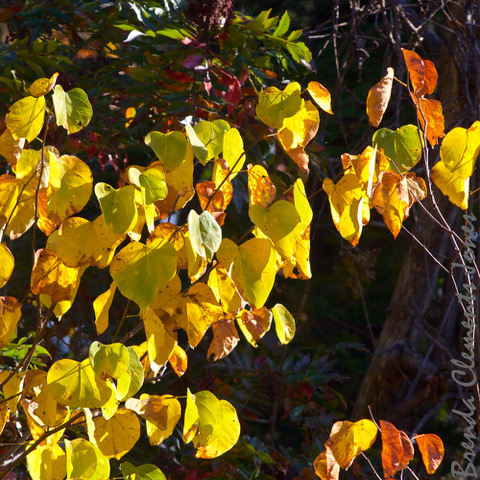
I count on Eastern Redbud (Cercis canadensis) for its pink in spring. Flowers blooming before leaves appear, but autumn is outstanding as well. Vibrant yellow marking the season.
Redbud is a small tree that is native to eastern North America, growing to a height of 20 to 30 feet, common in the forest understory up here.
_______________________
If you would like to receive my daily blog posts by email, sign up here!
Sweet Birch (Betula lenta) adding yellow to the colors of autumn. Native to eastern North America. Crushing the leaves, twigs and bark of Sweet Birch releases a strong, sweet wintergreen scent.
The bark of a Sweet Birch. A favorite spot for Yellow-bellied Sapsuckers (Sphyrapicus varius), who will drill small holes, called sap wells, in straight lines into the bark. These holes attract other bird species for the sap they release, and birds that come for the insects that arrive for the sweet sap.
_______________________
If you would like to receive my daily blog posts by email, sign up here!
Yum! Black Raspberries (Rubus occidentalis) native to eastern North America. Just beginning to ripen up here. They look quite similar to Allegheny Blackberries (Rubus allegheniensis) which also grow up here in the mountains.
Black Raspberries grow on bushes that have pale green stems and the berries are round, while Blackberries are longer than they are wide, and a bit larger than Black Raspberries. Another difference, Black Raspberries are hollow. Blackberries are solid. Black Raspberries also have a bloom similar to what is seen on Blueberries, though Blackberries do not have a bloom.
Yum, Black Raspberries are also sweeter than Blackberries.
_______________________
If you would like to receive my daily blog posts by email, sign up here!
Rain puddled on Coral Honeysuckle (Lonicera sempervirens). What a pure delight to see how much rain has fallen, yesterday evening and early this morning. The past couple months there has been very little rain and all the plants up here in the mountains are celebrating.
Coral Honeysuckle leaves are waxy, water repelling, or hydrophobic. The leaves immediately below the blooms of Coral Honeysuckle are fused, giving the appearance of the stem growing up through these joined leaves. They catch water when it rains. The puddles looking like gemstones.
Coral Honeysuckle is native to eastern North America and host plant to Spring Azure Butterflies (Celastrina ladon) and Snowberry Clearwing Moths (Hemaris diffinis).
_______________________
If you would like to receive my daily blog posts by email, sign up here!
An unusual flower color. Of all the flower colors, blue constitutes less than 10 percent. These blue flowers are Tall Bellflower (Campanulastrum americanum), native to eastern North America.
A plant that grows with a central stem, that is usually unbranched, to a height of 3 to 6 feet. Part of the common name, bellflower, takes me by surprise. The flower is quite flat as opposed to a bell shape. Nothing new, I am often baffled by colors that are included in common names. I guess there are others that see things differently than I see them!
________________________________
If you would like to receive my daily blog posts by email, sign up here!
Always be ready for whatever might present itself. Always be on the alert. Always have your camera with you, all set to take that picture.
And lo and behold, there it was. A Barred Owl (Strix varia). And I DID have my camera. All set!
The Barred Owl is native to eastern North America and is expanding its range, even into Alaska. It is 16 to 25 inches long and has an impressive wingspan of 50 to 60 inches. In the wild they will live 8 to 10 years.
I see these precious owls every now and then, around my cabin, and as I hike here on the mountain. This morning was one of those magical moments when I got to see and photograph one.
Seeming to take great pride in the range of motion of its little neck it seemed to say, “Look what I can do!”
A Tawny Emperor (Asterocampa clyton), one of my hiking buddies that keeps me company as I trek up the mountain. Native to the eastern half of North America from Canada to northern Mexico. Their sole host plant is the Hackberry tree (Celtis occidentalis). Plenty of those trees around here. As adults, these butterflies don’t go to flowers for their meals – what we would expect – but for food they go for carrion, sap and dung. Oh my.
It’s always fun to find a different native plant out in the woods. I never even knew that Huckleberries were actually a real thing until I found this bush. Black Huckleberry (Gaylussacia baccata). Along with this one, there are 3 other species of Huckleberry in this genus, Gaylussacia, which are found in eastern North America.
Bowman’s Root (Gillenia trifoliata) is a herbaceous perennial that grows to 2-3′ tall. It’s native to eastern North America from Ontario to Georgia.
Bowman’s Root is found up here in the mountains along the trails. It’s fun to find blooms with their five-pointed flappy star-like flowers. Right now the bushes are not in bloom, although some have buds. I expect in about a week there will be lots of flowers. I’m looking forward to seeing them again.