Turkey Tail Mushroom

Turkey Tail Mushroom (Trametes versicolor). A mushroom that’s commonly found throughout North America, also in Asia and Europe. It lives on standing dead trees, fallen trees or their stumps. And sometimes they’re found on wounds of living trees as well.

Turkey Tail Mushroom is saprophytic, which means that it creates enzymes which break down the cell walls of dead wood, supplying nourishment for the mushroom. As this process goes on, the mushrooms are helping clear the forest for new growth. 

In turn the Turkey Tail Mushroom is eaten by caterpillars of the Fungus Moth (Nemaxera betulinella), maggots of the Platypezid Fly (Polyporivora picta), and the Fungus Gnat (Mycetophila luctuosa).

But to me, one who roams the woods, in these mushrooms Mother Nature has created something to delight the eye.

Jack-O-Lantern Mushroom Revisited

Jack-O-Lantern Mushroom (Omphalotus illudens)

Today is Halloween. Time for Trick or Treat. But don’t get tricked into thinking that this mushroom is a treat. Visually, *DEFINITELY*. But not a treat to eat.

Eat the Jack-O-Lantern Mushrooms and you will get treated to headache, stomach cramps, vomiting, and or diarrhrea. Sounds to me like a wicked trick.

Jack-O-Lantern Mushrooms are said by many many sources to have gills that glow in the dark. I have serious doubts about this, after many unsuccessful attempts to see this phenomenon myself. Don’t depend on this to determine what mushroom you have discovered. You’ll be asking for trouble.

This beautiful mushroom is found east of the Rocky Mountains. They’re very common here in the mountains around my cabin. And it’s often found in urban areas too.

They’ll sprout up in large clumps from dead trees, stumps, and buried roots of hardwoods, particularly oaks, in the autumn. The time of year, and the color of the mushrooms, has paved the way for it’s common name.

Have a safe Halloween, and remember don’t eat mushrooms that you’re not totally SURE about.

A Drop of Rain

A glimpse of the whole world in a drop of rain.

Rain on the needles of Virginia Pine (Pinus virginiana). Three days of rain. One would think I’d be ready for it to stop. For the sun to come out and wipe the moisture away with a gentle brush. No I won’t wish the rain and gray skies away. Those gray skies create magic if you’ll just think about it. There are wondrous autumnal colors now. The magic of the gray skies are the strength of those colors. The darker the sky, the richer the colors, until they vanish into the darkness. Gray skies and rain are beautiful in my fall world.

More Hickory

Continuing on a thread that I started yesterday. These nuts are Bitternut Hickory. All Hickory nuts are edible but with this one, as the name implies, is one that you might want to skip. There are much better nuts in the woods.

Some moths have the Hickory tree as their host plant. One that is often seen in the fall is the Hickory Tussock Moth Caterpillar. Those long hairs are used as protection against predators and may irritate the skin of sensitive individuals. Use caution.

Another moth caterpillar that uses the Hickory tree as their host plant is an incredibly large one, the Hickory Horned Devil. Growing to 5.5 inches to 6 inches in length, it’s the caterpillar of the Regal Moth. Despite its size and amazing look the caterpillar is totally harmless with no poisonous spines.

The Regal Moth, the adult of the Hickory Horned Devil is of course large as well and can fill the space of a hand, with a wingspan of 4 to 6 inches. There are also butterflies that use Hickory trees as their host plants including Hickory Hairstreak and Banded Hairstreak.

Right now as autumn blazes through those Hickories are waiting to be discovered. Get out and look for the amazing golden glow, and compound leaf. Could be a Hickory.

Hickory Trees

There are eighteen species of Hickory in the genus Carya (from Ancient Greek for “nut”). Those eighteen, in turn, are in the Walnut or Juglandaceae family. Twelve of these Hickory Trees are native to North America. Right now on my mountain they are literally shining bright. The photograph above has Red Maple leaves in the foreground and gleaming through from behind are Hickory leaves in their autumn splendor.

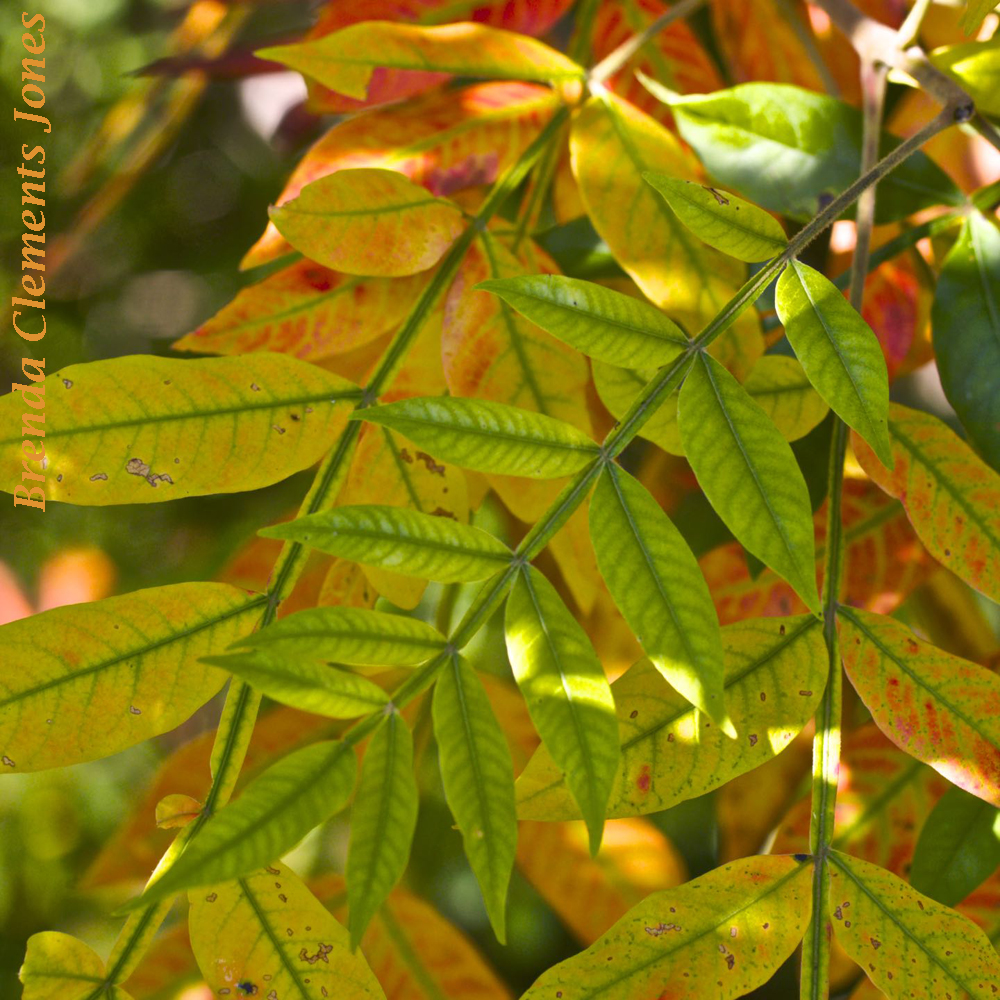
The leaves of Hickories are compound. They have leaflets growing opposite each other along the leaf’s central stem, or rachis, with a final leaflet at the end. All this comprises the whole leaf, an odd number of leaflets makes up one leaf, of all Hickory trees.

There are four species of Hickory native to Virginia. One of them, Shagbark Hickory, is quite common further up the mountain. It might be my favorite of the Hickories because its identity is so obvious. Easy is good.

Wheel Bug

The Wheel Bug (Arilus cristatus) is a true bug that uses its enlarged front legs to grab and hold its prey, then punctures it with a robust, curved beak which it uses to suck the body fluids from its victims.

It is part of a group of bugs called assassin bugs (family eduviidae). Measuring in at 1 to 1.5 inches, the Wheel Bug is the largest of about 150 species of assassin bugs here in North America. 

In the photograph above are young Wheel Bug nymphs. You’re asking for trouble if you pick up an adult or a nymph Wheel Bug. When handled carelessly (and who is to judge what that is?) a Wheel Bug will indeed bite, or perhaps a more appropriate word is pierce, a human hand creating a great deal of pain which lasts for many minutes and then the site becomes numb and that can last for days.

Another Wheel Bug nymph. This one, more mature than the red and black nymphs in the previous image. Despite their propensity to bite a hand that picks it up, a Wheel Bug is something that is beneficial to us. They make meals of critters that we generally don’t want to have in our gardens. Garden pests such as the Tomato Hornworm, Japanese Beetle, Mexican Bean Beetle, Leaf-hopper, Western Tarnished Plant Bug, Colorado Beetle, Striped/Spotted Cucumber Beetle, Aphids, Caterpillars and at the top of my list — Brown Marmorated Stink Bugs. Yes a mighty good one to have around. Just don’t pick it up.

Solomon’s Plume

Solomon’s Plume (Maianthemum racemosum), an herbaceous perennial in the lily family (Liliaceae). The berries are a brilliant crimson right now at the end of October, and easy to spot along trails in the mountains. Just as easy to spot, in the spring, are the flowers which bloom for about 3 weeks, late April into May.

Solomon’s Plume is native across most of North America north of Mexico in elevations of up to 9,000 feet. It is a plant that prefers partial shade, and deep, moist, soft soil. But it can be found in dry, rocky soils much like where it is growing when I see it in the woods on my mountain.

In the autumn the leaves of Solomon’s Plume die back, disappearing until the spring when the plants sprout up again from rhizomes and secondary fibrous roots. Those sprouts become arching, slightly zigzag stems with alternate ovate leaves.

The tiny flowers that appear on the end of those arching stems are pollinated by beetles, flies and bees. The berries which replace the flowers during the summer each contain a few seeds, are round, and 1/4″ across.

This is what the berries look like mid-July. Gradually they’ll become the bright crimson berries that are on the plants now in October, waiting for birds such as Ruffed Grouse and Veery to dine on them. Helping distribute the seeds, spreading the plants further through the woods.

Chicken of the Woods

Chicken of the Woods (Laetiporus sulphureus). A species of bracket fungus found in Europe, North America east of the Rocky Mountains, and parts of Asia.

Primarily found on oak, but also cherry, beech, chestnut and sometimes on conifers. These trees found with Chicken of the Woods growing on them are often dead or dying but the fungus is sometimes found on living trees as well. When the host tree contains toxins, as is sometimes the case, those toxins will be absorbed into that fungus making that fungus also toxic.

So many beautiful mushrooms. So many remarkable fungi. Such amazing colors right here on my mountain. So many marvelous things to be discovered.

_______________________

If you would like to receive my daily blog posts by email, sign up here!

Ruby-crowned Kinglet

Ruby-crowned Kinglet (Regulus calendula). They spend their summer in far northern North America and the western mountains. Winters are spent in the southern and southwestern United States and Mexico. Some mountain populations in the West relocate to lower elevations during the wintertime. And now they’re here on my mountain. I’ve seen one or two the past few days looking for insects in nearby trees.

Their diet throughout the year is mainly insects but during the winter months they’ll also eat berries and seeds.

The male has the distinctive ruby crown. Other distinguishing features of both male and female are the white wing bars against black bars, the white incomplete eye ring, and the habit of constant wing flicking.

The measurements of this bird – a length of 4 inches and weighing just .25 ounce makes it one of the smallest songbirds in North America. I sure am glad to have these tiny creatures back in my woods.

_______________________

If you would like to receive my daily blog posts by email, sign up here!

A Coral Mushroom

A Coral Mushroom. Perhaps a Smoky Worm Coral (Clavaria fumosa/rubicundula). Captured in pixels because as I hike through the woods I go slowly. Very slowly. The more slowly I proceed, the more I see. The more discoveries I make. Not discoveries that will shake the scientific world but discoveries that will bring great jubilation to my heart. That’s how I tick. Get out there and find Mother Nature at her best.

For me it is not the number of miles I achieve, but what I find. So many mushrooms. So many insects. So many flowers waiting to become part of the perfect composition. There is so much out there just waiting for me. If only I will go slowly. If only I will look. If only I will take it all in. With my camera.