Bobcat

Certainly something that I would not have expected to find anywhere around my cabin. Something that doesn’t make itself known very often at all. But on rare occasions I get the thrill of my life, when a Bobcat (Lynx rufus) makes an appearance. These creatures are secretive in nature, solitary, territorial, and nocturnal, most often hunting at dawn and dusk. Their favorite meal is rabbit but they’ll hunt down squirrels, rodents, lizards, snakes, skunks, muskrats, beavers, ground-nesting birds and even deer. They sleep during the day in multiple den areas which can be hollow trees, rock crevices or rock piles, caves, brush piles and even abandoned beaver lodges.

Adult Bobcats are about twice the size of a domestic cat. Weighing in at about 13 to 30 pounds, standing 18 to 24 inches high, and are 30-50 inches in length. In the wild they can live anywhere from 5 to 15 years. Their range is all of the continental United States, from southern Canada to northern Mexico, living in areas of dense vegetation.

I haven’t seen a Bobcat in a while but I’ve been watching and waiting. Maybe one day soon.

Confusing Bumblebee

Confusing Bumblebee (Bombus perplexus). Native across Canada and south into the eastern portion of the United States. This critter surprised me when I saw it. I’m not used to seeing bumblebees are are almost entirely yellow. What a thrill to see. The flower though is not such a thrill. It’s Spotted Knapweed (Centaurea maculosa), which is native to eastern Europe and has become highly invasive across most of North America. Watch for the Confusing Bumblebee come spring and summer, and I hope you don’t see the Spotted Knapweed.

________________________________

If you would like to receive my daily blog posts by email, sign up here!

Io Moth Caterpillar Stings!

Io Moth Caterpillar (Automeris io), a beautiful creature that feeds on an extensive collection of plants including corn, roses, sassafras, willow, linden, elm, oak, locust, redbud, apple, beech, ash, currant, and clover. Quite the wide variety.

The young caterpillar is orange. As it grows it changes color, and as a mature caterpillar it is bright green with bright green spines. The spines have a very irritating venom that is delivered with the slightest touch. As is the case with many caterpillars, look but don’t touch.

Dark-spotted Palthis

Looking much like the Northrop B-2 Spirit, Stealth Bomber. But don’t get confused, it’s a moth. A Dark-spotted Palthis (Palthis angulalis). The caterpillar of this Palthis eats leaves (living or dead) of shrubs and trees, including Alder, Ash, Basswood, Birch, Pine, Spruce, Willow; and of forbs including Aster and Goldenrod. I love that they eat dead leaves. Much appreciated. And they’re found Newfoundland west to coastal British Columbia, south to Florida and Texas.

In the Blink of an Eye

In just a month or two, just the blink of an eye, Bloodroot (Sanguinaria canadensis) will be emerging. Working their way up through the leaf litter of the woods. Not so long from now.

A member of the Poppy Family. Native to the eastern half of the United States and southern Canada. Look but don’t touch. And for goodness sake, don’t eat it. This plant can cause a rash if touched, and is toxic if eaten in large amounts.

The flowers don’t last very long, just a few days. Enjoy them as they brighten the woods!

Rain in February

Rain yesterday. Rain today. Rain in February, 1.25 inches. Much needed. It should have been snow, but the temperatures were much too warm for February. But the trees, the plants, each and every one happy.

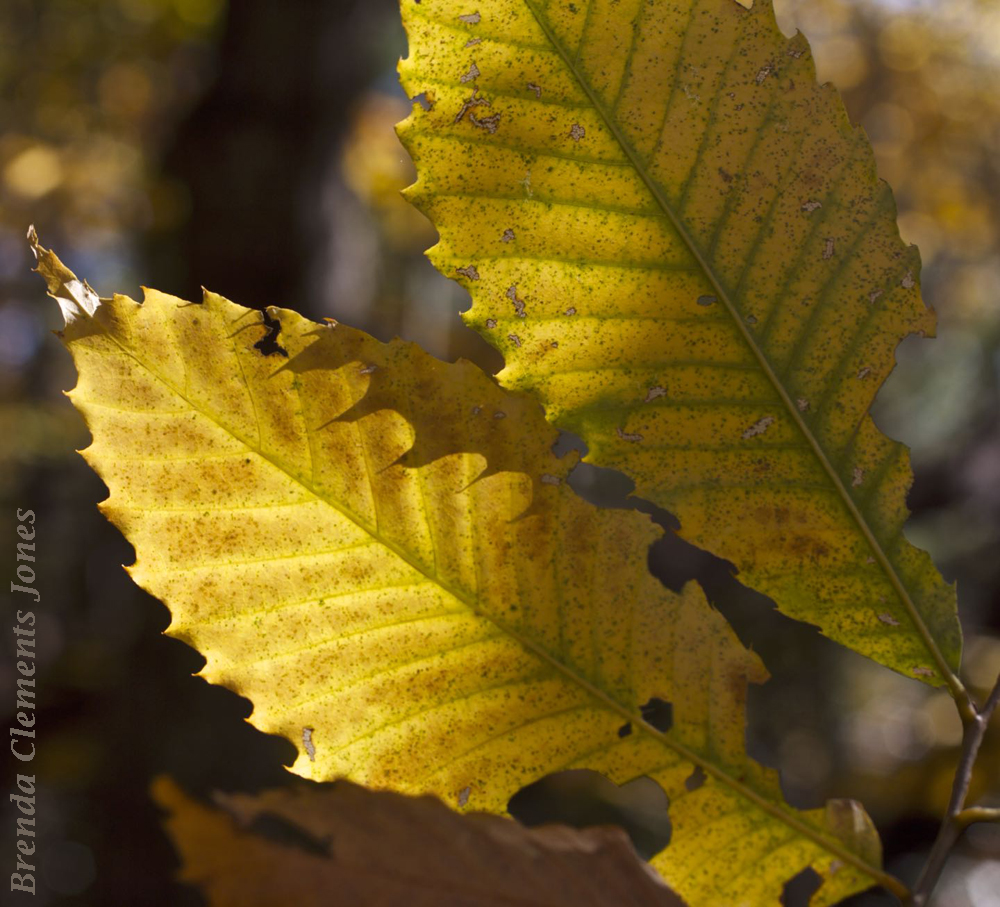
And in the rain, one of my favorite things in my world of nature, here on my mountain. American Chestnut (Castanea dentata) with their rain soaked leaf edges a classic ocean wave pattern.

More Oriental Bittersweet

More and more Oriental Bittersweet vines (Celastrus orbiculatus) seem to be magically appearing in my woods. It’s not literally magic though. The female vines produce berries which birds and other berry eating animals dine on and then distribute the seeds far and wide.

And that is where the little seedlings appear. Far and wide, even where no other such vines exist. This seedling is exactly what I search for. The easiest way to stymie these vines. A simple task of pulling it up. I like to take along a trowel to ease it out of the soil.

As you pull it out of the ground, if you see bright orange roots — BINGO! You’ve got an Oriental Bittersweet seedling. That orange is what you want. Whether it is the root of a seedling or the root of a mature plant it will be orange. Be sure to leave the seedlings or other parts of the plant, to dry for a couple days, on a surface where it won’t take root again. Concrete, a tarp, in the trash. Don’t let it have another chance.

Don’t be fooled. I’m referring to the plant as a vine, but it can appear to be a trailing shrub too. Trying very hard to fool us. Pale green, inconspicuous blooms arrive in May, and by July, green berries appear.

By October the yellow capsules that contain brilliant red berries are ready to open to join the leaves that are turning yellow for an autumn celebration.

Oriental Bittersweet is an aggressive, rapidly growing vine that smothers out other plants quickly. It wraps around anything it can find, including itself. Hoping you don’t find any.

Oriental Bittersweet

I’m sad to say, an exotic invasive, Oriental Bittersweet (Celastrus orbiculatus), is spreading rapidly throughout my woods. This is what the vine looks like right now in the middle of winter. Red berries encased in bright yellow capsules, that get eaten by birds and other animals and then distributed by the critters, often long distances away. Oriental Bittersweet is dioecious, which means pollen and fruits come from separate male and female plants. That in turn means that if you see these berries, you are more than likely only seeing half the Oriental Bittersweet plants – only the female plants.

And another image of Oriental Bittersweet as it looks right now, midwinter.

Native to China, Japan and Korea this difficult to control vine was first introduced to the United States sometime around 1860 as an ornamental plant. 

More on identification of Oriental Bittersweet in my next blog post.

Lavender and Cabbage Whites

Skipping months ahead, June, and Lavender will be blooming. Ah that scent! I love it. Most people enjoy it too but many insects, including fleas, ticks, flies, and moths are repelled by the scent. As you can see, apparently not Cabbage White butterflies (Pieris rapae). Along with other butterflies, bees are attracted to Lavender, who feed on the pollen and nectar.