Zion National Park, easily one of my favorite national parks. And in that park, rooted in a crevice in an incredible soaring rock wall, an Indian Paintbrush (Castilleja coccinea) showing what determination can accomplish.
Meteorological Spring

Ah, the change of seasons. How I love the change. How boring it would be if we only had one season. And now the beginning of meteorological spring. Soon flowers will be bursting forth with a cacophony of color. What a change from the impressive, black and white/pen and ink drawing, landscape of winter.

One of the first, a very early wildflower, Twinleaf (Jeffersonia diphylla), is native to eastern North America. It is a plant that I must remind myself to hunt for. It emerges, buds ready to open, well before I’m used to finding wildflowers blooming.

Here in the mountains of central Virginia, that crucial time is late March into early April. Each flower only lasts for a very few days, so searching at the right time is important.

As the flowers enjoy their few days, the leaves hold back, not to come into their own until the show is done for the blooms.

Then it becomes evident why this plant has the name, Twinleaf, with its appearance of butterfly wings or angel wings, a pair of leaves joined at the stem.

Then comes the seedpod which starts out with the look of a goblet and as it matures it takes on the appearance of a comicstrip character with a mouthful of seeds.

The Twinleaf has seeds that ants are attracted to. These seeds are carried by the ants to their nests, because they have a fatty appendages, called elaiosomes, which the ants feed to their larvae. In the process, the seeds remain intact and are discarded, where they often take root. This process, which is surprisingly common is called myrmecochory. And who would have thought – ant farmers!
Today at the Birdbath

Yellow-rumped Warbler (Setophaga coronata), a winter visitor. I don’t see them at the feeders. Sunflower seeds, jelly, raisins, suet, and peanut butter are said to attract them but here on the mountain I am having no luck except with the bird bath. I sure am glad they enjoy that.

The Yellow-rumped Warblers do eat berries that grow here, either in my yard or close by. Among those berries native to this area are Poison Ivy berries, Juniper berries, and Dogwood berries.

Now, to be honest, I’m not going to encourage Poison Ivy but I might just look the other way if I see some growing at the edge of the woods. I know that there are many birds that enjoy it, including these cute little birds that show up every now and then at the birdbath.
Pileated Woodpecker

Well THAT certainly was strange. The poor Pileated Woodpecker (Dryocopus pileatus) trapped between the glass of the window and the screen which he has just crashed through.
This afternoon we were in the living room when we heard a very loud thump. We immediately went to the porch, knowing that sound. The thump of a bird that crashed into a window. But this was a much larger bird than we have had crash in previous incidents. A Pileated Woodpecker has a length of 16 to 19 inches and a wingspan of 26 to 30 inches. I have always felt confident that the screens we have in nearly all of our windows are a life saver for birds. That certainly was the case with this critter.

He appeared to be uninjured but still very frantic. Upon crashing into the screen it had ripped an L-shaped tear. He was flitting up and down the narrow space between the glass and the screen, going to the opening but managing each time to miss slipping through.

Using his bill in a very efficient way, he was creating more holes. And creating an escape route if he were able to work on it long enough. But Bill opened the window next to this one and with a yardstick, opened the L-shaped flap. With pure luck and no sense of what he was actually doing the woodpecker flew to freedom. Hallelujah.
Colorado Blue Spruce
A little bird, a Phoebe (Sayornis phoebe), sits atop a Colorado Blue Spruce (Picea pungens) as if it were the tree topper on a Christmas tree, trying to ask you, “What is YOUR favorite Christmas tree?”

I’m a very visual person so my choice of Christmas tree depends entirely on how it looks. Soft needles are not a characteristic of the Colorado Blue Spruce. Its needles are sharp and can be painful to deal with but that’s okay with me. It’s my perfect tree for decorating at Christmas. Its color fascinates me. The blue happens because of a wax that is produced on the needles in spring and early summer. That wax may erode thanks to wind, hard rains or hot sun leaving the needles with a more green color. When the tree has its traditional blue-green-gray color it reminds me of looking in a mirror at my own eyes.

It’s native to the central and southern Rocky Mountains in the states of Arizona, Colorado, Idaho, New Mexico, Utah and Wyoming.

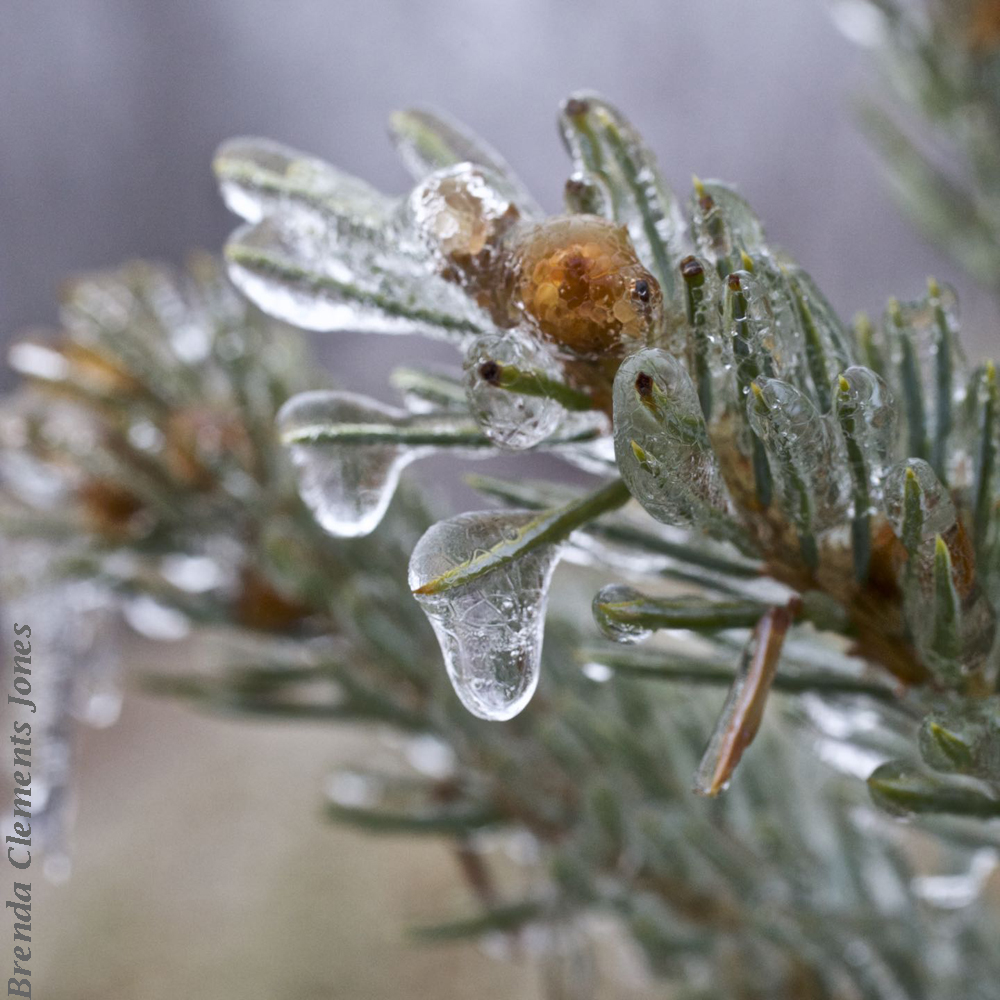
In the wild a Blue Spruce can grow to 135 feet tall and 30 feet wide. One stunning tree that can live more than 200 years. And in the image above, a beautiful part of the tree, a new growth bud.
Iced Witch Hazel
With temperatures up to 73° two days ago, yesterday’s temperatures were a pleasant surprise (says the lover of winter), fluctuating around 30° with nothing registering higher than 31°. But it was raining lightly with very little icing, and no snow. That was a weird disappointment. Last night though ice happened. My world was covered in diamonds as I got ready for my day. I was elated.
My Witch Hazels (Hamamelis virginiana) near the back of my studio looked dazzling in their dressing of ice. This small tree is a rebel in the world of flowering trees, blooming in October and November, hanging onto those blossoms for a couple months. Witch Hazels are native to eastern North America. Here in the mountains I see many of them in the higher elevations. They’re one of the host plants of Spring Azure butterflies.
Vultures

I often meet the nicest people at the dump (and recycling center, THAT makes it sound better). And I often also see Vultures there. There are two species of Vultures in Virginia, Black Vultures (Coragyps atratus) and Turkey Vultures (Cathartes aura). There are subtle differences between the two, some of which you can even see as they fly past.
Something I notice right away as a Turkey Vulture soars above is the silvery white on the underside of their wings. That silvery white is on the trailing back edge of the wing, from the very tips all the way to the bird’s body. Those wings create a six foot wingspan. Mighty wide. They “float” as they ride the thermals with their wings held in a dihedral (shallow V) shape, seeming to wobble from side to side instead of flapping which saves them energy. Their tails are long, even longer than their toes as they fly. With a closer look you’ll see that they have a bald red (often bright red, sometimes dark red) head. Adult Turkey Vultures have a white bill. They have an incredible olfactory system, the largest in the bird world, which allows them to smell their dinner, carrion, from more than a mile away.
Both the Turkey Vulture and the Black Vulture have no feathers on their heads. This helps them stay clean as they stick their heads inside carcasses while scavenging. It also helps them with temperature regulation.
The Black Vulture is very similar to the Turkey Vulture, but if you take the time, it’s pretty easy to tell the difference between these two Vultures. Wings are different. With the Black Vulture only the wing tips are silvery white, like silver fingers. The wingspan of this Vulture is five feet. As they fly they hold their wings out flat, rather than in the dihedral shape of the Turkey Vulture. Flight consists of several flaps of the wings then a short glide. The Black Vulture sports a short roundish tail. They hunt by sight, not smell.
Though Vultures have a reputation of being rather creepy they’re a tremendous benefit to our environment, cleaning up roadkill and carrion and rids areas of wildlife diseases that those dead animals might be carrying.
Christmas Cards

Christmas cards are something that I’ve created for years. No telling how long it has been, just many many years. All year long I’m wondering what will be my choice as December draws near. It’s early in the year and though the high temperature today was 73° there’s a chance of weather appropriate for the subject of a card coming up tomorrow. Snow? Sleet? Crazy weather. It is not supposed to be in the 70s on February 23. But maybe tomorrow will make up for it. Bring on the cold.

Northern Cardinals (Cardinalis cardinalis) seem an appropriate subject, particularly if snow is involved. No need for me to entice Cardinals to come to my feeders. I think I’ve got the magic draw without giving it any thought. Black oil sunflower seeds and a bird bath filled with water.

These birds that don’t migrate. I appreciate that. They’re here all year long. Adding crimson or buff to the landscape whether against the many shades of green of summer or the blacks and whites of winter.

Northern Cardinals are included in a long list of birds that will attack reflections of themselves not just in windows or mirrors but chrome bumpers, shiny grills, gazing balls, or similar shiny surfaces. They become convinced that what they see is a rival bird and will attack it incessantly. Right Gary? There are many suggestions listed on the Internet on how to discourage this behavior. Seems that it takes as much determination on the homeowner’s part as the determination the Cardinal has to overcome the problem.
But for me, I am looking forward to tomorrow and seeing what the weather brings. Maybe the perfect scene for a Cardinal to pose for a Christmas card. Got my fingers crossed.
Common Blue Violets

Today, again, I’m doing the ever present task of “housekeeping” or organizing my photographs. Aside from the prime benefit of doing this chore, being able to find some particular photo when I need it, it also gives me the opportunity to see images that I took long ago. Ones that I had forgotten about. Ones that perhaps needed to be brought to my attention again. That could be the case of this one.
The wonderful Common Blue Violet (Viola papilionacea). A flower that makes me think of a precious friend, Ana. Ana’s Mom is 104 years old and loves Violets. I see these beautiful flowers and think of her. A native plant that I love to have show up in the grass around my cabin. A flower that I enjoy having volunteer in my gardens. They’re the host plant of Fritillary Butterflies, and it is because of Violets that we have Fritillaries. Thank you Violets.
Thinking about Mayapples

While doing some “housework” with my photographs this afternoon I came upon this image of a Mayapple (Podophyllum peltatum). Not remarkable on its own, but with the knowledge of the date it is something to take note of. That date, just five days from today. The end of February. February 26, 2018. That really took me by surprise. After noticing that date, I immediately dropped everything and went out to the forest edge where the Mayapples live but found nothing. Not a hint.

But I’ll be watching. Patiently waiting to see what appears to be little umbrellas emerging from the soil. Watching and waiting for those parasols to spring up and begin their unfurling.

I’ll be looking for the double leaves that indicate a single flower will make its presence known in the axil of those two leaves. Only one leaf, no flower. Soon, spring.