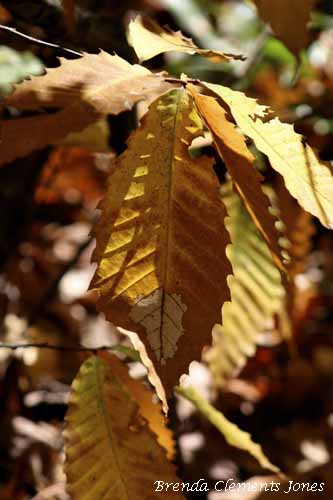
Oh it is so very nice to be back in autumn again. I spent a few days traveling to Florida and got to experience the change of seasons all over again. I traveled south into summer and green green green. Returning yesterday I got the thrill of seeing the mountains covered in their autumn best. Golds, yellows, reds, oranges and lovely burnt siennas. Colors that tell me snow will be soon arriving. I can hardly wait.
These leaves, putting on a welcome back show for me, are American Beech (Fagus grandifolia). Leaves that are reminiscent of American Chestnut leaves with their ocean wave edges. No wonder. They are in the same family, Fagaceae. Ahh! What color. How nice to be back in autumn.
Oh but the things to come. Color. The color of Virginia Creeper with it’s crimson leaves.
Brilliant color. All the leaves that had been cool greens now becoming warm colors. Rich colors become ubiquitous. Red Maples turning red or orange or yellow.
Another Red Maple. This one scarlet with yellow as an accent.
PawPaw becoming chartreuse.
Sassafras uncertain if it should turn yellow or orange. But either one, rich warm color.
American Chestnut, yellow and rust.
All these colors. An invitation to enjoy the colors while they’re here.
Hawaiian shave ice. Snow collects in the cone shapes that American Beech (Fagus grandifolia) leaves make during the winter. It reminds me of a trip long ago. A trip to Hawaii to see a total solar eclipse. A trip to be introduced to Hawaiian shave ice, which brings me back to the subject of my post.
Beech trees are obvious during the winter up here on my mountain. They are a tree that is shade tolerant and will happily grow at an unhurried pace, just waiting for surrounding trees to decline and provide that lovely spot of sunshine. Their marcescent leaves make them stand out against the many gray trunks of larger trees. If not for the drooping sepia leaves that cling until spring their smooth gray bark would blend right in.
As the tree matures that smooth gray bark doesn’t change much. Whether a young tree or an older tree, it still looks like the skin of an elephant.
The leaves of American Beech brings to mind another member of its family Fagaceae, the beloved American Chestnut tree, which has a very similar, ocean wave edge to its leaf.
Another point that you might keep in mind if you are looking for an American Beech tree, is its leaf buds which resemble thorns. Nothing to worry about though. They look like thorns but they’re friendly.
Those leaf buds will expand come spring, the leaves unfolding into emeralds to decorate the summer vista. Then in autumn they will shout with warm color, yummy splendor.
I was greeted by a whole new world yesterday, as I hiked up the mountain. I’d been down in Florida and not able to check on things up here for more than a week. When I left, autumn was on the downswing. Now, I am greeted by what looks like a winter landscape. Just browns, blacks, whites, grays and a stray bit of evergreen. This is good! I love to have the seasons change around me, welcoming each one as it approaches.
Bark! Bark!
As winter creeps into our area, it’s time for me to change my focus. From butterflies and insects, to bark and buds.
Hey Bud!
These are the buds of Spicebush, Lindera benzoin. They are out there in the forest, right now, just waiting for spring, to burst into a soft wash of lemon yellow.
Not Chinese Chestnut
The bark of Spicebush puts me in mind of the young branches of Chinese Chestnut, Castanea mollissima, a tree that is often confused with American Chestnut, Castenea dentata. The Chinese Chestnut has lenticels (breathing pores on the bark of trees) that are pronounced and feel like course salt on a pretzel. I think this bark looks like a salted pretzel, like the Chinese Chestnut. This is the bark of Spicebush.
Another Shade Of Gray
Another small tree bark that I am working to get to know is Witch Hazel, Hamamelis virginiana. Both Witch Hazel and Spicebush are small trees or large shrubs that grow in look-alike groupings. I can count on the bark of each, to let me know which I am looking at, during the winter when there are few other clues. Witch Hazel (above) also has visible lenticels, but they are elongated, fewer, and the bark in general has a rosey-gray appearance, while the coloring of the Spicebush bark is more a green-gray.
Subtle Coloring
I look forward to a season of gentle coloring. Almost monotone, like a black and white pen sketch, beautiful in its simplicity.
I was pleased this morning to be able to tell a dear friend that the trees he thought might be American Chestnuts, Castanea dentata, were indeed, the not often found species.Yay! This is good. I had mixed feelings though, because at the same time, I had to tell him that his trees would definitely succumb to chestnut blight. That is of course unless some crazed, chain saw wielding person comes along and cuts the trees down.
Ocean Waves
The first thing I looked for on my friend’s trees – the classic ocean wave of the leaf edge. The leaf in the photo above is one that I pressed to save, since it has the perfect example of the American Chestnut leaf edge. This morning the leaf edges were a bit hard to see since it is so late in the season, and the leaves were curled and dry, but I was encouraged by the edges I could see. Also the shape of the leaf is like a canoe – quite pointed at both ends. And an American Chestnut leaf is generally 5 to 9 inches long.
Lenticels
Another thing I took into consideration was the bark of the trees. American Chestnuts have easily visible lenticels, or breathing pores, that look like fine salt on a pretzel. These trees did have these lenticels. Chinese Chestnuts also have these lenticels, but they look like large salt grains. My friends trees had an appearance of fine salt grains.
Tootsie Rolls Anyone?
Another sign of an American Chestnut is the color of the twigs, a rich Tootsie Roll brown, along with those lenticels. Again the trees passed the test. Last but not least, I took into consideration the environment that the trees are living in – forested land with no clearing. American Chestnuts are shade tolerant trees, surviving in shade, just waiting for an opportunity to capture sunshine and shoot up to their tallest potential. Chinese Chestnuts are not shade tolerant. Good news, Buddy! I feel you’ve got several American Chestnut trees. Keep your fingers crossed, and if you are very lucky, they may grow to be sizable trees!
One Ridge North
As I was checking out Buddy’s trees, I was taking in the beauty of his property, one mountain ridge north of mine. He’s a landscape architect and his property reflects what a person in this profession would have, if he was guided by Mother Nature. He lives in the woods, surrounded by native plants. I was struck by one native in particular. One that I blogged about yesterday: Beautyberry, Callicarpa americana. The photo above is his native species. See how the berries cluster on the stem, like poufs on a French poodle?
Mine – Not A Native
While Buddy has the native, I get the booby prize, with my Purple Beautyberry, Callicarpa dichotoma, (above) which is not a native to North American, but of the Far East!
Chinese chestnut is a being used as a source of resistance for the American chestnut tree. This picture: monarch butterfly on Chinese chestnut flowers.
Stories From Long Ago
You might be fortunate enough to have family accounts from the older generation of gathering chestnuts, or of your granddad building a fence from chestnut trees on his farm. I don’t have those stories in my family traditions, but still I fell in love with the American chestnut tree when I heard of its history.
American chestnut burs typically have up to 3 seeds. If you’re going to handle them, it’s suggested you use leather gloves!
So Many Trees
Before 1900, the American chestnut tree (Castanea dentate) made up approximately one quarter of the trees in its range, an area of two hundred million acres. Its native range extended from Maine and Ontario, south to Florida and Alabama, and northwest through Indiana and Illinois. The tree had lived in this area for thousands of years.
The American chestnut tree was large in the forest. Historically it grew to 100 feet tall and 10 feet in diameter. This American chestnut snag was found in Madison County, Virginia.
So Quickly Gone
Late in the 1890s, as Americans began to import chestnut trees from Asia and Europe, the chestnut blight (Cryphonectria parasitica) was accidentally brought with them. The Asian and European trees had lived and evolved with this fungus for generations, but it was new and deadly to the American chestnut. The blight was an airborne fungus introduced to the trees through any number of otherwise small injuries. It spread rapidly and within 50 years of the blight’s introduction it wiped out up to three billion American chestnut trees.
The delicious American chestnut is an excellent source of vitamins, minerals and is low in fat.
Important To The Economy of Appalachia
The American chestnut was an important crop in the Appalachian Mountains. It had a superior taste compared to the Asian and European chestnut and there was great demand for it. The nuts provided a great source of income for the people of these mountains, who also fattened their cattle and hogs on the nuts under the chestnut trees. It was an important tree for wildlife, the nuts providing a reliable food for deer, black bear, and wild turkey. The tree was a valuable hardwood timber tree. It was easy to work with and highly resistant to decay. The tannins in the bark of the tree were also used to tan leather.
I was thrilled to find some small American chestnut trees growing on the mountain where I live, in central Virginia.
There Are Still A Few Around
Today in the forests of the Blue Ridge Mountains, and all over the native range of the American chestnut, every now and then you will find a small cluster of little American chestnuts trying to survive. You might think of these trees as American chestnut “bushes”. They will not grow tall and proud as the trees once did. The blight does not kill the roots, so the trees keep sending up new growth. A new sprout will shoot up, grow for a few years and die thanks to the chestnut blight that has attacked so many of these trees.
Volunteers planting American chestnut seeds at the Virginia Department of Forestry.
Hard At Work to Bring Back This Treasure
Scientists and volunteers working with The American Chestnut Foundation have been crossing American and Chinese chestnut trees then backcrossing the offspring with other American chestnuts in an attempt to develop a tree with the traits of an American and the blight resistance of a Chinese chestnut tree. There is great hope that this goal has been reached but much more research needs to be done. Only time will tell. Check back in 100 years or more.
An American chestnut seedling which is planted with great hope for the future of our forests.