The Journey

Imagine you are a winged, feathered creature, just 3 inches long, weighing in at 0.1 to 0.2 ounces. Imagine too that you spend the summer months in Canada and other parts of eastern North America, and you spend the winter months from southern Mexico southward across Central America to Panama. That’s what Ruby-throated Hummingbirds (Archilochus colubris) do every year. Traveling Hummingbirds flying back and forth alone.

They have no maps or GPS help. They somehow know where they are going and manage to rejoin other Ruby-throated Hummingbirds after a trip of 1,000 to 1,600 miles. And if the Hummingbird should choose to cross the Gulf of Mexico (some do, some don’t) they fly that 500 miles over 18 to 24 hours (weather dependent) non-stop.

Incredible. Just thinking about it makes me feel very worn out. I think I’ll sit down.

Raspberry Awakening

So many native perennials sprouting their leaves as if little alarm clocks have gone off telling the plants to wake up. One of them, Purple-flowering Raspberry (Rubus odoratus), sending out its maple-like, very crinkled, serrated leaves. It is native to the eastern United States

By late May bristly buds appear. The stems and branches of the plant are also hairy/bristly but have no thorns.

Blooms arrive by mid-June in the woods in the Blue Ridge Mountains. Often singly, sometimes two or three blossoms together. The drupes or berries are edible but it is debatable whether they have a good flavor. I chose to leave the drupes for the birds and animals that enjoy them.

It’s a great kick to find these flowers in the woods. A lovely bright color for a native plant.

A Transformation

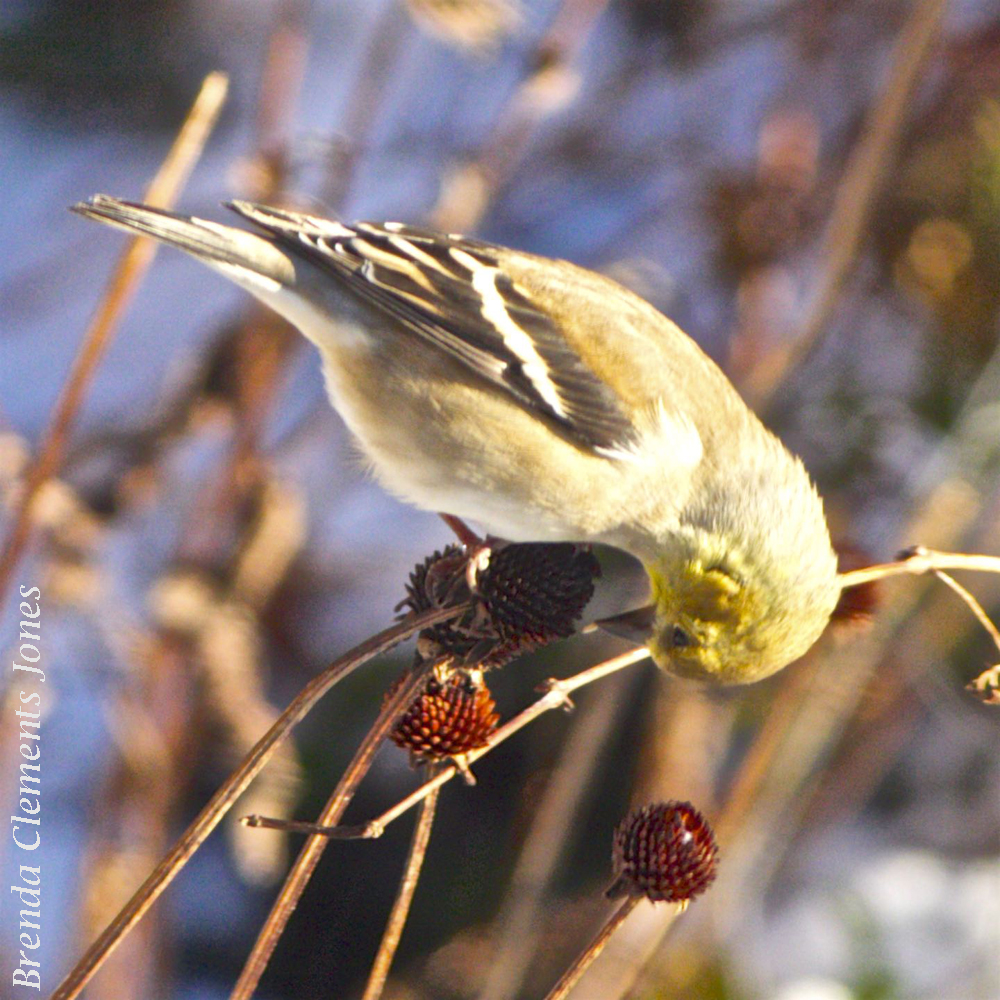
In trying to come up with words to describe the intermediate stage of an American Goldfinch (Spinus tristis) transforming from winter to summer garb, I immediately think of “patchwork quilt” but that is not quite right. After all quilts are beautiful pieces of art. This intermediate stage is an unfinished work, still in progress.

The first image is that transformative time, that intermediate stage, changing to a different outfit. Going from winter to summer garb. Goldfinches molt two times during the year, once in late winter and again in late summer. This photo, above, is of a male Goldfinch in his winter outfit. Trying to blend in as best he can.

And of course this is the outfit we all know to be the male Goldfinch in his summer suit. All set to knock our socks off with that smashing color.

Falcate Orangetip

This afternoon the butterfly gods, or maybe it was the butterfly fairies, were taking care of me. I was out refiling the bird feeders when I spotted a small white butterfly nectaring at a Confederate Violet (Viola sororia priceana). Normally this butterfly, a Falcate Orangetip (Anthocharis midea), flutters by occasionally but rarely do I see it stop to take in some nectar. When I first spotted it, my camera was not with me and I figured my chances were nonexistent that it would still be there when I got back with it. BUT much to my surprise the Orangetip was waiting for me and its chance to have a portrait created.

Orangetip caterpillars live on blooms, developing fruit and leaves of plants in the mustard family such as Rock Cress, Bitter Cress, Shepherd’s Purse and Toothwort. Adults nectar at Toothwort, Mustards, Violets and Spring Beauty.

In its name, the “orangetip” is obvious. The first portion of the name, “falcate” means bent like a scythe or sickle, as the crescent moon, and certain leaves; hooked; curved and tapering to a point. Now keep that in mind as you look at the outer edge of a forewing. See that very subtle hook?

It is the male that has the orange spot on the upper, or dorsal, side of its wings. The female is totally white and black. Both male and female have a black spot in the middle of their forewings. These butterflies vary in size from 1.3 to 1.75 inches. The female is usually the larger of the two sexes.

It’s one of the early butterflies. Spring is upon us!  

Spring Azure

Spring Azure (Celastrina ladon). With a wingspan of just 1 inch, it’s a tiny white butterfly that flutters through the woods as an adult beginning in mid-March but in that stage only lives a few days.

The larval host plant of the Spring Azure is Flowering Dogwood, Blueberry, Viburnum and there may be others.

The upper or dorsal side of the Spring Azure is a pretty blue which can be seen in flight, or if you’re very fortunate you might get a glimpse of the upper side of the wings as it lands and opens its wings. Most often though it has its wings closed trying to blend in with its surroundings as it attempts to send you the message, “You can’t see me!”

First Tiger Swallowtail

I saw it fluttering about today, this afternoon. Checking out the blossoms. Wondering if they were open, but no, not quite. A few more days and the nectar will be there for the taking. It’s the first Tiger Swallowtail (Papilio glaucus) of the year.

Image from 2016

All Set for Hummingbirds

A feeder went up today in anticipation of the arrival of Ruby-throated Hummingbirds (Archilochus colubris). I’m hoping the first Hummingbird will be here very soon. They’re such a joy to have around. Here you see a female. Those tiny white tips on her tail indicate a female and not a juvenile male. A juvenile male would have a white throat like you see here, and slightly speckled like this or even more speckling, but no white on his tail. She’s enjoying Scarlet Beebalm (Monarda didyma) nectar. That’s a perfect plant for Hummingbirds.

White Wood Asters

Like many things early in April, White Wood Aster (Eurybia divaricata) is emerging from the soil to greet spring.

I’m thrilled to see it in many places in the woods up here. An herbaceous perennial found in the eastern US and southeastern Canada but most often found in the Appalachian Mountains.

One of the first asters to bloom in autumn densely covering the plant with small, white, daisy-like flowers with bright yellow centers that fade to dull purply red. These charming blossoms top dark purple stems.

The nectar of the White Wood Aster is attractive to butterflies and the American Lady (Vanessa virginiensis) seems particularly drawn to the flowers. A butterfly, much to my delight, that seems to enjoy being a model for my photos.

Emerging Trout Lilies

We met along the shore of the Rivanna River in the Key West area of Charlottesville. So many things were to be discovered. It was this very day, in April 2010, and it was part of my training to become a master naturalist. That trip allowed the first time ever, for me to see the tiny plant, Trout Lily (Erythronium americanum).

Every spring now, from its very first day as winter is left behind, I am on the lookout for the first signs of the Trout Lily coming up. Here you see that sign. A single leaf emerging from the soil. When the plant matures and blooms, there is a second leaf. From year to year plants will send up a single leaf but not necessarily a bloom or a second leaf. I found this leaf yesterday, the first Trout Lily leaf so far. This particular one, just a teeny 3/4 inch tall.

It was such a surprise to me, that first sight of a Trout Lily all those years ago. Such a very small bloom, growing on a flowering stalk 6 inches tall. Easy to miss if you aren’t looking for the little things. That’s me. Always looking for the little things. The things that others miss.

Virginia Bluebells just Beginning

The air was still today. A very welcome respite from the whipping wind of the past few days. The warmish spring weather and bright sunshine called to me. My camera and I roamed looking for ephemerals making their appearance, and I returned with many images to add to my stash.

One discovery, Virginia Bluebells (Mertensia virginica). At this point in their short lives I find they are not showing their exceptional blue, but glorious purple and brilliant pink.

The exceptional blue I mention in the Virginia Bluebell is something special since only 10% of the world’s 280,000 flowering plant species have blooms that are truly blue. For those of us that are lovers of the color blue, that makes this one a special flower.