The Scarlet Berries Of Jack

jackinthepulpit

True Red

At my back porch, I have a wonderful cluster of berries, a color that would be perfect for a Christmas display — a true red.  These are the berries of a Jack-In-The-Pulpit, Arisaema triphyllum, a plant that is native to the moist woods of eastern North America.  The plant gets its name from the odd flower that emerges in the spring.

jackinthepulpit2

The Pulpit

The “flower” consists of a flaplike spathe which shelters the little fellow, Jack, who is sitting in the pulpit.  Jack actually is covered with the real flowers of the plant — both male and female flowers.  The flowers are pollinated by flies that are attracted to the plant by heat, that the plant produces much like skunk cabbage does, and by scent.  The pollination results in the brilliant red berries, which each contain one to five seeds.  New plants from these seeds need three or more years before they are able to produce a flower.

jackinthepulpit3

Flower Color

The color of the Jack-In-The-Pulpit flower varies from a pale yellow-green, to a rich emerald green, to green with dark purple or brown stripes.  I find flowers of these various colors here on my mountain.  They are all the same species.

jackinthepulpit1

Careful

All parts of a Jack-In-The-Pulpit contain calcium oxalate crystals which can cause irritation of the mouth and digestive system, and can affect breathing.  On one site on the internet, I see a warning that this plant is not to be confused with poison ivy, since both plants have leaves made up of three leaflets.  I find that amusing, since I doubt that anyone would want to eat poison ivy either!  Deer don’t seem to have any problem with the calcium oxalate crystals.  I have found that Jack-In-The-Pulpit is one of their favorite foods.

Jack-O-Lantern Mushroom

JackO1

Watching For The Jack-O-Lantern

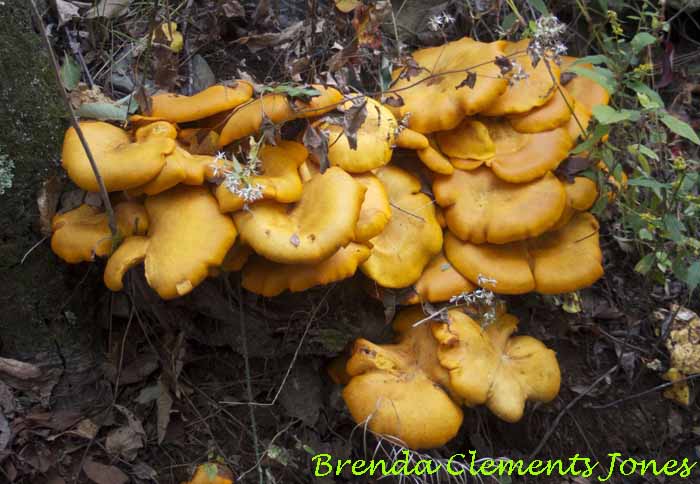
I’ve been watching, not for the Great Pumpkin, but for a large cluster of Jack-O-Lantern Pumpkins, Omphalotus illudens.  Day before yesterday, they popped up.  I think if I had been sitting there watching and waiting for them, I would have seen them spring up from the dark, dry soil, since I have been watching for them daily.  But there they are.  A huge clump of them.  Really a wonderful sight to see!

JackO

Wild Color

For several years now, growing at the base of a long dead oak tree, there has been a patch of  mushrooms, a color best described as radioactive orange.  They grow in a cluster, much larger than most mushrooms I’ve seen, and they emerge later in the season than many other mushrooms.

JackO2

Wild In Other Ways

Not only do they have a wild color, but their gills glow in the dark.  Mighty cool, don’t you think!  A perfect name for them – Jack-O-Lantern – since they are such a Halloweenish color and they glow in the dark.  And those of you who might have thoughts of eating this mushroom — do not!  This mushroom is poisonous!  I’ll enjoy watching them while they are still around this season and I will watch for them again next autumn!

Blackhaw On The Mountain

blackhaw

Buds and Snow White Flowers

From mid-April through mid-May the Blackhaws, Viburnum prunifolium, are in bud and bloom up here in the Blue Ridge Mountains.  The Blackhaw is a shrub or small tree that gets its name from the inky black of the fruit, that develops during the summer, and ripens in the fall.

BlackHaw3

Fruit or Drupe

The floral display turns to fruit in June.  This fruit, which, seems to me would be called a berry, is actually called a drupe.  They start out apple green and oblong.

BlackHaw1

Blushing

As the summer days pass, the apple green gains a blush of dark pink and then crimson as the sun shines on the drupes.

BlackHaw

Overnight Changes

Each day as I hike the mountain, as summer turns to autumn, I see changes.  I’m surprised at how quickly one little drupe will turn from its crimson red to inky black.  It just takes one night and presto! there is another one, blue-black and ripe.

Preserves And Wine

There are sites on the internet that mention Blackhaw preserves and wine.  Sure would take a large amount of these drupes to make anything at all.  Though tasty, they are mostly a single, large seed.  Birds and wildlife enjoy eating the Blackhaw fruit.  I think I will leave the drupes for them!

A Good Day For Monarchs

Monarch1

Oh What a Day!

I think it was just a perfect day!  After finding a sincere pumpkin patch and locating a large, golden orange squash that would please even the Great Pumpkin, I returned to my cabin to find a Monarch butterfly, Danaus plexippus, enjoying the many varieties of asters that I have in the yard.  What a delightful surprise!  During this butterfly season, from spring until now, I had only seen a grand total of two Monarch butterflies.

Monarch5

Mid-Summer

My first Monarch sighting was in mid-July, way up the mountain.  He was flitting back and forth from one fleabane flower to another.  It was another month until I saw another one, just one.  I managed to get some pictures of the first one (above) but the second sighting went without photographs.

Monarch3

Where Are They

In other years, the Monarchs have been much more plentiful.  The photo, above, was taken in June 2010 and shows a Monarch feasting on a purple coneflower.  My gardens this summer have had lots of purple coneflowers blooming.  It didn’t attract any Monarchs though.

Monarch2

Sunflowers?

It made no difference that sunflowers were around, Monarchs just weren’t there.

Monarch4

Gaillardia?

It made no difference that gaillardia was blooming in my garden earlier this summer.  But today I saw 6 or 7 of these beautiful, rich orange and black creatures!  Hooray!  These butterflies are beginning their long migration, all the way to Mexico.  I wish them well, finding plenty of good weather and the foods they need along the way.

Caterpillar Of The Monarch Butterfly

More Milkweed

I’m going to be putting more native Milkweed, Asclepias, in my garden.  Milkweed is the only plant that Monarch larvae eat, and I want to make them feel at home here on my mountain!  AND I will be reading, and listening to reports from scientists who study butterflies to learn why there have been so few this butterfly season.


Treasures In The Woods

AmChestnut

A Special Corner

This is a special bend in the road on my hike up the mountain.  Here I find fun mushrooms and cool little lichens that could be the center of an elf village.  But the real treasure for me, is the sprouts of American Chestnuts that are just up the slope at this bend.

AmChestnut2

Almost Gone But Not Quite

The American Chestnuts have almost been wiped out by a fungus, commonly known as “the blight.”  What is generally now found in some, lucky woods, are sprouts of determined trees, still trying to survive.  That is what I have found on this bend in the road.  Sprouts.  I wouldn’t call, what is occasionally found these days, American Chestnut trees, but American Chestnut bushes.

AmChestnut3

Ocean Waves

The leaf of the American Chestnut has a distinctive, ocean wave edge, and the leaves that I find in the woods right now are a rich emerald green, as in the first close-up shot.  By the end of October those leaves will turn a warm golden brown.  I have to smile whenever I see these leaves – so determined to survive.

AmChestnut1

Waiting on Virginia Creeper

vacreeper4

A Common Plant Here

Virginia Creeper is a very common plant here in the Blue Ridge Mountains.  I enjoy seeing it, with its five leaflets radiating out in its palmate fashion.

vacreeper3

Five Leaflets

Those five leaflets create one leaf.  They are so precise with their sawtoothed edges, like a seamstress has taken her pinking shears to each one.

vacreeper1

A Climber

The vine loves to climb trees, like a child in an apple orchard.  This beautiful creeper, above, is clinging to a Persimmon tree.  A tree with a gorgeous checker board pattern, that it earns as it ages.

vacreeper2

A Garland

I’ve been watching this garland of Virginia Creeper, draped over a downed tree since spring.  I’ve imagined that it would be so lovely in the fall, in scarlet.  As you can see, I’m still waiting.  Sometimes things don’t go as I had imagined.  Will those leaves turn a brilliant shade of red, or just wimp out on me?  Stay tuned.  I’m still watching and hoping!

Nothing But Blue Skies

Light Shining Through Red Maple Leaves

Perfection!

The days recently have been absolutely yummy.  Blue skies, low humidity – perfect for hiking during the day and wonderful for sleeping at night.  It’s been a dream, being able to hike up my mountain and watch as the leaves change from their summer blue-greens to their autumn tones of chartreuse, lemon, lime, golds, mango, crimson and every color in between.  The colors are changing much more rapidly than I ever expected.  Of course, I’ve never in my life observed nature so closely as I have the past many months.

Sassafras, Going From Rich Deep Emerald To Lemon And Lime

Changes

Some things are slowing down.  I’m not seeing nearly as many new flowers now.  Goldenrod season seems to be coming to an end.  Asters in shades of snow white, lavender and grape are still going full speed ahead but I don’t see many buds left on them, to open when I’m not looking.  The next big floral display I’m awaiting, is the opening of the Witch Hazel.  That will be a delight when it happens, and I’ll photograph the blossoms and share them with you.  I expect that won’t happen for another several weeks though.

My Turn-Around Point

Ferns

I’m watching, each trip I take, out the gate and up the road, to see what happens.   I’ve spotted many patches of beautiful ferns along my daily route.  My turn-around point is marked by Maidenhair Fern on one side, and Sensitive Fern on the other.  The Sensitive Fern has been given that name because it quickly withers and dies back when the temperatures get to be too cold.  I’m watching to see at what point in the season that will happen.  Fortunately the woods are also filled with many evergreen ferns, such as Christmas Fern, so I’ll be seeing that finery as I go about my observing during the winter.  Another beautiful season to look forward to!

Sumac For Autumn Color

Blossoms Of Winged Sumac, Rhus copallinum

Pollinator Pleasing

In mid-summer there is quite a draw at my wood’s edge.  The Sumac is in bloom and pollinators are buzzing all over the flowers.  I have two types of Sumac — Winged Sumac and Smooth Sumac, supplied by Mother Nature.

Fruit Of Smooth Sumac, Rhus glabra

For The Birds

From blooms to fruit, pleasing different critters.  The fruit of the Sumac attracts birds throughout the winter.

Common "Yellow-Shafted" Flicker, Colaptes auratus
Common “Yellow-Shafted” Flicker, Colaptes auratus

Welcome Food During The Snowstorm!

With blinding snow coming down, this Yellow Shafted Flicker was able to find a meal at one of my many Sumacs.  This picture was taken in February 2010.  We had 72 inches of snow here on the mountain during that winter. It was wonderful!

Winged Sumac, Rhus copallina

And Now The Season Of Color

Sumacs turn brilliant shades in the fall.  A little bit at a time.  I’m enjoying taking pictures of just one branch or two, dressed in an outstanding scarlet set against the rich emeralds of its past summer finery.

Winged Sumac, Rhus copallina

Or . . .

Or tropical shades of limes and lemons, set against the warm colors of papayas.

Smooth Sumac, Rhus glabra

More Color To Come

In the next two months Sumacs will be turning on more scarlet, making the wood’s edges sing.  A song I look forward to!

Welcome Autumn!

Red Maple, Acer rubrum

Let The Season Begin!

Autumn started this afternoon!  Yay!  I love to experience the seasons — each and every one — all four, to their fullest potential!  As always, autumn is starting slowly.  Yes, we’ve had cooler weather, but the leaves are slow to respond and are waiting for the days to get shorter and shorter.  I have to really look to see any leaves turning.  The patch of Red Maple leaves, above, being true to their name are a beautiful scarlet, but I had to hunt for them.  Most trees are still green.

Flowering Dogwood, Cornus florida

An Exception

Dogwood is an exception to that rule.  If you’re really observant, you’ll notice that the Flowering Dogwood begins, ever so subtly, to turn from green to red, in early July.  I noticed this a few years ago and it sorta blew my mind, but every year since, I’ve noticed the same thing happening.  Not every Flowering Dogwood tree goes by this pattern, but most that I see here on my mountain do.

Clasping Aster or Late Purple Aster, Symphyotrichum patens


Asters, Asters Everywhere!

On my daily hikes Asters are the most abundant flower.  Snowy white asters with sunshine yellow centers that turn to warm burgundy as they mature.  Lavender asters – small and even smaller ones.  And my favorite – grape purple asters with the name  Clasping Asters or Late Purple Asters.  The flower of this species is a tiny bit larger than most of the Asters I’m seeing.  It’s the smashing grape color that really gets my attention though.  I’m really a sucker for a yummy, rich color.

Goldenrod, Species to be determined later!

Brilliant Yellow

I cannot leave out the Goldenrod that greets me each time I hike up the mountain.  Beautiful yellow Goldenrod that is such a cheery sight.  Oh dear!  So many different species (over 50 in North America) that I have not begun to try to figure out which I’ve been running into.  I think I’ll leave that to those long winter days when there are no flowers to identify as I hike!

Locust Borer (Megacyllene robiniae) Blending In With Goldenrod
Locust Borer, Megacyllene robiniae, Blending Right In With Goldenrod


Brilliant Yellow In Insects Too

A frequent sight on the Goldenrod — the adult Locust Borer enjoys the pollen of the Goldenrod.  The species gets its name from the larvae that bore into Black Locust Trees.

Silverrod, Solidago bicolor

Bold Identification

One plant in the Solidago (Goldenrod) genus that I feel confident identifying is Silverrod.  I just saw it for the first time a few days ago and it fascinates me, looking like a Goldenrod but it is white with just the smallest hint of yellow.  Nice to have something with no question of what it is!

Colors To Come!

As the days get shorter, the leaves will respond, shutting down their production of chlorophyll, which will bring about the change in colors that I’m waiting for.  I’ll keep you posted!

Happy Yellow!

Opening Sunflower Photo2

Happiness!

Yellow is such a happy color!  I had a dear friend, Pat Gallagher, whose favorite color was yellow, I think for that very reason.  She was a truly happy person.  She made a point of doing watercolor paintings, and making quilts with the warm color in it, even in the day when yellow was not favored.

Yellow But Not A Sunflower

The flower below, with its gorgeous curvy stamens is not a Sunflower, but a Wingstem (Verbesina alternifolia).  I see it along roadsides at the foot of the mountain where I live.  I’ve got one plant of it in the front of my cabin, due to my curiosity about it, and my seed collecting habit.  Nice to have it added to the many yellows provided by Woodland Sunflower and Goldenrod!

Wingstem3

A Favorite Flower

My Dad’s favorite flower is the sunflower.  Whenever I order a bouquet for Mom and Dad, I try to have the florist include sunflowers in the bunch to make both Mom and Dad smile.  Yellow and sunflowers, they just work together so well.

YellowAndRed

Not Yellow

This ladybug is not yellow, but I think she’s pretty happy wandering about in her yellow flowered world.  Yellow has a way of attracting birds and insects.

Speaking of bees, do you see the face created by the bees in the picture below?  Happy bees!

BeeFace

Fading

Even fading yellow appeals to me.  These sunflowers, in the two pictures below, well beyond their peak, are beautiful!

Drooping


YoungAndOld

New Yellow

And a most comforting sight, a bud of a sunflower, just thinking of opening, starting a new life, providing sustenance for birds, and bees.

YoungAndOld

_______________________________________________________________________

If you would like to receive my daily blog posts by email, sign up here!