Flowerpot Parasol

Flower pot Parasol (Leucocoprinus birnbaumii). I must always find out what it is, whether a plant or animal that I’ve encountered on a trail or, as in this case, something that mysteriously popped up alongside one of my orchids. That’s just how my brain works. I love a mystery and must get an answer. This answer has the perfect and most clever name. The Flower Pot Parasol.

My orchid lives outside during summers, and surely a local mushroom just popped in to take up residence. But after checking things out on the Internet that seems not to be the case.

I would never expect to find a mushroom growing with one of my potted plants, but here it is. And I’m told this particular one is the most common to show up in this way, in a pot, thanks to green houses and potting soil. Normally it grows in the wild in tropical and subtropical regions. Mystery solved and I’m feeling lucky to have a Flowerpot Parasol.

Indigo Lactarius

Mushrooms intrigue me, particularly the ones that emerge in surprising colors. This one certainly fills that stipulation. Indigo Lactarius (Lactarius indigo).

Mycorrhizal, or having a symbiotic relationship, with pines and oaks. Indigo Lactarius will grow in a large group or a small group, or alone in summer and fall.

Found in North America from the northeast to the southwestern United States, Mexico, Central America, East Asia and in middle of my lane.

Jack-O-Lantern Mushroom

JackO1

Watching For The Jack-O-Lantern

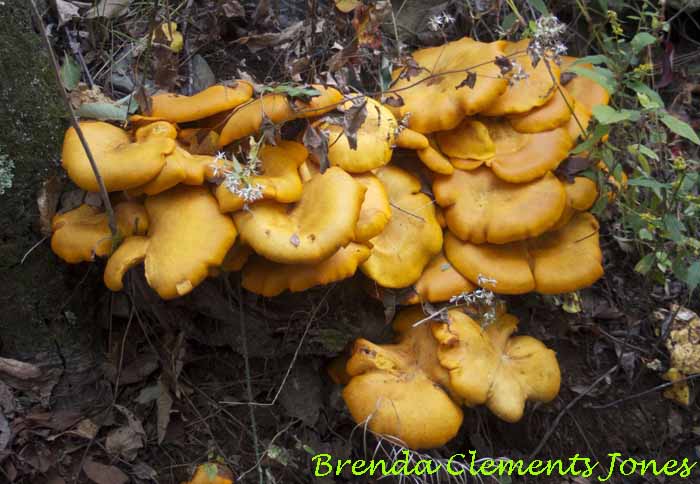
I’ve been watching, not for the Great Pumpkin, but for a large cluster of Jack-O-Lantern Pumpkins, Omphalotus illudens.  Day before yesterday, they popped up.  I think if I had been sitting there watching and waiting for them, I would have seen them spring up from the dark, dry soil, since I have been watching for them daily.  But there they are.  A huge clump of them.  Really a wonderful sight to see!

JackO

Wild Color

For several years now, growing at the base of a long dead oak tree, there has been a patch of  mushrooms, a color best described as radioactive orange.  They grow in a cluster, much larger than most mushrooms I’ve seen, and they emerge later in the season than many other mushrooms.

JackO2

Wild In Other Ways

Not only do they have a wild color, but their gills glow in the dark.  Mighty cool, don’t you think!  A perfect name for them – Jack-O-Lantern – since they are such a Halloweenish color and they glow in the dark.  And those of you who might have thoughts of eating this mushroom — do not!  This mushroom is poisonous!  I’ll enjoy watching them while they are still around this season and I will watch for them again next autumn!

Turquoise Mushrooms!

Blue-green Wood Stain Mushrooms, Chlorociboria aeruginascens

The Last Day Of August

I was out extra early this morning for my hike.  That’s a mighty good idea during the summer, since there are rain showers or thunderstorms so often in the afternoons.  This summer that has certainly been the case.  It has been much more rainy than a normal summer, and I’ve gotten good and drenched a couple times!

Blue-green Wood Stain Mushrooms, Chlorociboria aeruginascens

So Many Mushrooms!

I can’t say what a normal summer of mushrooms is, since this is only the first summer I’ve been keeping an eye on Mother Nature up here, but it really seems like we’ve got quite a plethora of these amazing things.  I’ve been amazed at the variation of color in the mushrooms.  Seems like every color of the rainbow is represented.

Blue-green Wood Stain Mushrooms, Chlorociboria aeruginascens

A Few Days Ago A New Color

A few days ago, I came upon a new color, one that I had never seen in a mushroom before — turquoise!  I took photos and came home to find that I had not gotten the focus just right.  Another trip up the mountain brought the same results.  These mushrooms are very tiny – about 1/4 inch across and focusing is a challenge but today, success!  Yay!

Blue-green Wood Stain, Chlorociboria aeruginascens

Blue-Green Wood Stain

As you can see in the photo captions, these mushrooms are Blue-green Wood Stain Mushrooms, Chlorociboria aeruginascens.  The book I often use for mushroom identification, Mushrooms of West Virginia and the Central Appalachians, by William C. Roody, says that actually finding the fruiting body (or what we call the mushroom) is a bit unusual.  What is normally seen is just the stained wood, as in the picture above.  Interesting!  And another beautiful mushroom color!

Blue Mushrooms, Really?

Viscid Violet Cortinarius -- Gill View
Viscid Violet Cortinarius — Gill View

What a beautiful color!

Recently some friends and I have been marveling over the beauty of the color periwinkle.  Yesterday, as I hiked my mushroom covered mountain, I came upon a mushroom of that very color.  What a thrill!  Who would have thought there would be a periwinkle mushroom?  Okay, okay, this color is perhaps leaning just a *tiny* bit toward the purple side but I’m still calling it periwinkle!

Indigo Lactarius -- Gill View
Indigo Lactarius — Gill View

Another blue mushroom

In my mushroom picture taking past, I had run into another blue mushroom and I thought perhaps it might be the same species. My first task was to find those photos.  I have a wonderful system of filing photographs by whatever keyword I might choose.  Unfortunately I have to assign a keyword for the system to *work*, and I had not assigned any keywords for that blue mushroom.  So, to my more than 40,000 picts (the ones that are digitized) I went, searching for old blue.  It was years ago, but I had no idea exactly when.  In the 2006 grouping I came up with it.  An Indigo Lactarius, Lactarius indigo (Schwein.) Fr., and not the same species as my newfound periwinkle mushroom.

Indigo Lactarius -- Top View
Indigo Lactarius — Top View

Research

My brain requires that I find the name of everything that I run into, on my hikes.  Since my periwinkle mushroom was not an Indigo Lactarius, this meant that I *had* to dig out my books, look up mushroom websites and figure it out.  At first I was discouraged and didn’t think I’d figure it out but I came upon a wonderful site with loads of good photographs and that helped provide my answer.  My periwinkle mushroom that I discovered yesterday is a Viscid Violet Cortinarius, Corinarius iodes Berk. & M.A. Curtis.

Viscid Violet Cortinarius -- Top View
Viscid Violet Cortinarius — Top View

Mystery solved!

Hooray, my research paid off!  I love a mystery, but I need to have the mystery solved too.  In the case of my colorful blue mushroooms, my mystery has been solved!