White-banded Crab Spider

A female White-banded Crab Spider consuming its catch on an Orange Echinacea

White-banded Crab Spider (Misumenoides formosipes). The body length of a female is about 1/4 inch to almost 1/2 inch. The body of a male is about 1/10 inch. The color of a female, who has the ability to change color – could be yellow, white or pale brown. That color will depend on where the spider is sitting, and what color is surrounding the spider. There is sometimes a marking on the abdomen of the female that is red, brown, or black.

A male White-banded Crab Spider on Asters

The male White-banded Crab Spider has a shiny caramel-colored abdomen and the cephalothorax (or upper body) is yellow, green or red. Both the abdomen and the cephalothorax remain the same color throughout the male spider’s life. Its long front four legs are darker than the back legs.

This spider is not associated with spinning a web. It will simply sit on a flower and wait for its prey to come by and the spider will ambush its dinner. Beware! Who knows what lurks in those flowers!

Sleepy Orange

If only you could see the whole series of images that this one came from. The series is like a dramatic opera without music but so much movement! Butterflies love this flower, Tithonia rotundifolia. That’s the orange flower that caused the drama. I highly recommend it if butterflies bring you pleasure. An annual plant that requires me to remember each year to plant it. Best of luck, if you’re like me and don’t necessarily remember little things like planting this, that, or the other thing at the proper time of year.

But let me get on with the topic at hand. The Sleepy Orange (Eurema nicippe). There are two of them in the small photo above. These beauties can be found in North America, the West Indies, Costa Rica and Belize.

The wing span of the Sleepy Orange is between 1.5 and 2 inches, or about the size of a Cabbage White. The host plants include Cassia, Clover, Wild Sennas, and Partridge Pea. The adult Sleepy Orange loves to sip nectar from flowers using its tongue like a straw.

The flight period of the Sleepy Orange in Virginia are generally June until October. Sometimes several are seen “puddling” or gathering around a puddle or patch of wet sand where they get sips of water along with the natural salts they need.

Northern Walkingstick

It wasn’t too long ago that I became aware there was an insect called a “walkingstick.” A creature that I would have marveled at as a child. During my growing up years I spent loads of time in the woods, but never did I see such a thing. I’m delighted now that I know about these critters.

This Northern Walkingstick (Diapheromera fermorata) is native to North America. Its range in the US extends from the Atlantic coast, Maine to Florida, west to New Mexico and north to North Dakota. In Canada it is found in Alberta, Manitoba, Ontario and Québec. Northern Walkingsticks have built-in eye protection that acts to shield them from excessive sunlight. 

They have an incredible camouflage, looking like a twig, and will keep their legs close to their body and remain perfectly still when they sense predators, such as American Robins or Crows are nearby. Sometimes a predator only gets away with a leg. These clever insects often are able to regenerate that lost leg. Northern Walkingsticks are found in deciduous woods and forests. They seek out oaks and hazelnuts, skeletonizing their leaves.

Lobelia inflata

Incredibly tiny flowers that grow on slightly hairy stems. At just 1/3 inch long the flowers would be perfect for a dollhouse. Lobelia inflata flowers are a beautiful shade of pale blue-purple. Native to eastern North America.

A bit of conflict on the Internet regarding whether Lobelia inflata is poisonous or not. More sites say it is than the ones that say it is not. My suggestion, don’t eat any part of this plant.

Lobelia inflata is an annual or biennial herbaceous plant that likes moist areas and sunshine. Given its favored conditions it can grow to 3 feet tall. But still those flowers are mighty small.

As the flowers one by one fade, the seed pods grow and expand like small balloons. These seeds pods are an indication that you’ve come upon the right plant. You have come upon Lobelia inflata.

Blackberry Lily Revisited

Wow! She’s about to go into second grade. But even as a toddler, she’s always wanted to help me scatter the Blackberry Lily (Iris domestica) seeds.

Those seeds reveal why this plant has its name. But the name is a bit misleading since Blackberry Lily is not actually a lily at all but a species of iris. And a word of caution, those seeds contain toxins. Beautiful, but don’t eat!

Thomas Jefferson was smart to bring this plant with its striking flowers to his gardens at Monticello. It’s native to eastern Russia, China and Japan.

A well behaved resident not only of Monticello’s gardens, but also my gardens. The plant grows from rhizomes and the seeds that we enjoy scattering together, but it’s not at all aggressive in its growth.

Larger Elm Leaf Beetle

Larger Elm Leaf Beetle (Monocesta coryli) is 3/8 to 5/8 inch long.

Quite a pretty beetle with its colorful iridescence, the Larger Elm Leaf Beetle can be found in the eastern and southeastern US, from Florida west to Kansas and north to Pennsylvania. Elm is a favorite tree that this beetle feeds on, but it also skeletonizes the leaves of Hawthorn, Hazelnut, Flowering Dogwood, River Birch, Pecan and Plum. It’s most often spotted in hardwood forests and woodlands that have a lot of elm trees.

The larvae of Larger Elm Leaf Beetles start out just after emerging from their eggs at 1/8 inch long and greenish-yellow to 3/4 inch long and looking like this photo.

Adult Larger Elm Leaf Beetles chew holes in leaves and lay their eggs on the leaves. The larvae aren’t shy though and don’t hold back, they consume everything but the veins of leaves as they feed.

A view from below. Looking up at the larvae of Larger Elm Leaf Beetles

The Tachinid Fly, and parasitic wasps use Larger Elm Leaf Beetles as their hosts controlling to some extend their population.

_______________________

If you would like to receive my daily blog posts by email, sign up here!

Red-eyed Vireo

The Red-eyed Vireo (Vireo olivaceus) is a summer resident here at my Virginia cabin. They are constantly reminding me that they’re around, though I seldom see them. Their normal place to be is high up in the tree tops while hunting for their meals, out of sight. Their summer diet is predominantly insects of all sorts, including mosquitoes, flies, caterpillars, as well as spiders and small snails. They’ll also eat plant materials like small fruits, and an occasional flower or leaf bud.

They remind me that they’re up there in the tree tops by singing to me. I use a mnemonic to remember the males’ song. They sing over and over again, “Here I am! Where are you?” Keeping that mnemonic in mind makes it easy to recognize their song. Both the male and the female will participate in their calls which are a Catbird-like “myaah.”

The Red-eyed Vireo spends its breeding season across forests of southern Canada and throughout the woodlands of the northwestern, central, and eastern US. As they migrate they fly long distances at night in groups of up to thirty, sometimes including other species like warblers, tanagers and flycatchers. Their fall migration destination is northern South America and the Amazon Basin.

A Difference Between Moths and Butterflies

Not brightly colored. Not large. But a butterfly. Little Wood Satyr (Megisto cymela).
Not dull colors. Certainly not small. But a moth. Luna Moth (Luna Moth (Actias luna).

I keep reading about moths having drab colors and butterflies having bright colors. Don’t depend on that to decide which you are looking at. There are brightly colored moths. And there butterflies that have dull colors. I also see it being said that moths are small and butterflies are large. That can’t be depended on either. There are very large moths and very small butterflies. Another point I often read: moths are nocturnal and butterflies are diurnal. But in reality there are butterflies that are nocturnal and there are also moths that are diurnal.

The feathery antennae of a male Yellow-collared Scape Moth (Cisseps fulvicollis).
The sawtoothed antennae of a female Black and Yellow Lichen Moth (Lycomorpha pholus).

One thing you can depend on in looking to see if you’re seeing a moth or a butterfly is their antennae. Male moths have feathery antennae while female moths have sawtoothed antennae.

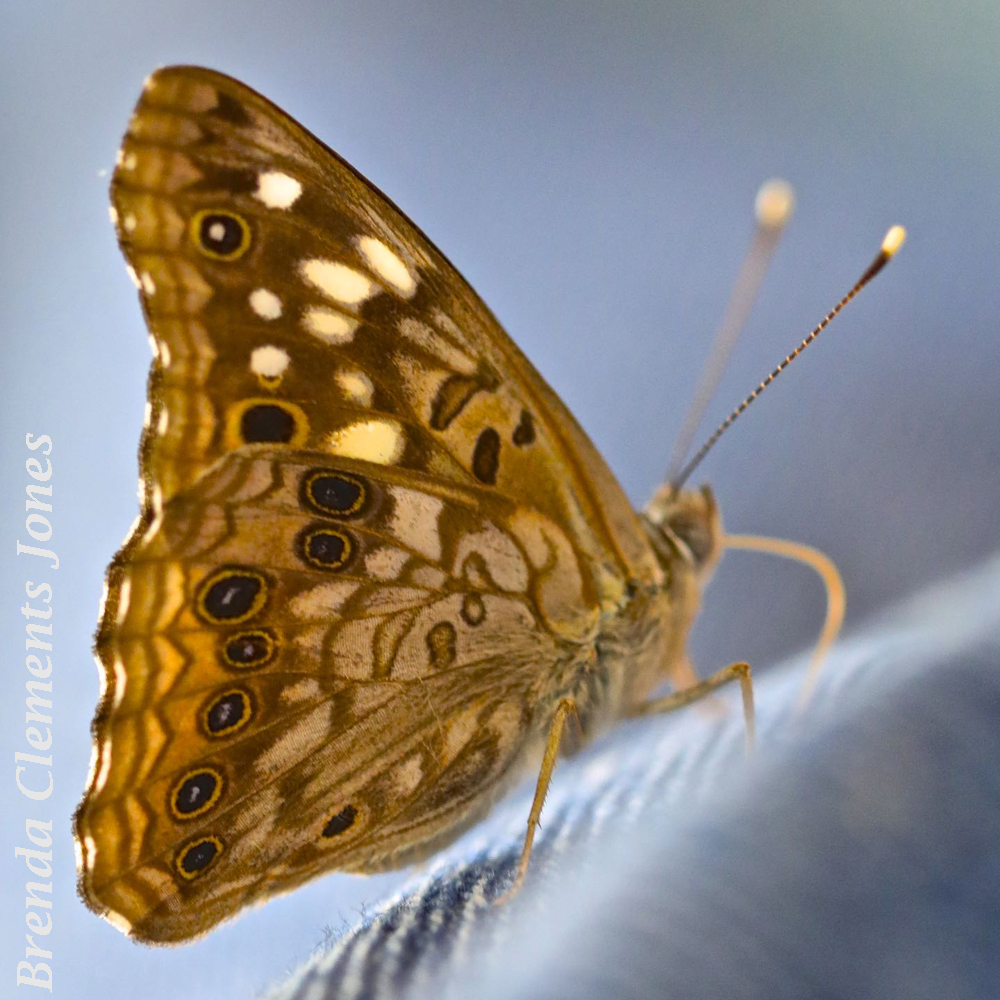
A butterfly with its antennae. Long shafts with club-like bulbs at the ends. Hackberry Emperor (Asterocampa celtis).

A butterfly’s antennae are long shafts with club-like bulbs at the ends. A moth’s antennae, whether a male or female, do not have those bulbs on the ends.