Brenda is a certified Virginia Master Naturalist, a Habitat Defender for Shenandoah National Park, and a devoted fan of Mother Nature. She lives in a cabin in the Blue Ridge Mountains near Shenandoah National Park, and hikes up to the higher elevations of her mountain often to see what nature is up to. Her constant hiking companion is a camera that captures nature as it unfolds through the seasons. It’s her goal to share the natural world around her through her photographs.
A butterfly that I love to see, in part because it seems to be so unpredictable. I sometimes see them in late summer through autumn — maybe. This is a Common Buckeye (Junonia coenia) on a favorite source of nectar, from the family Asteraceae, a Small White Aster (Symphyotrichum racemosum).
_______________________
If you would like to receive my daily blog posts by email, sign up here!
Out, roaming with no thoughts of wasps, when this Gold-marked Thread-waisted Wasp caught my attention. Sitting on a leaf, looking all of its .8 inch length.
They’re found in North and South America. As adults they drink nectar from flowers including, Yellow Ironweed (Verbena alternifolia), Mountain Mint (Pycnanthemum), Goldenrod (Solidago), Culver’s Root (Veronicastrum virginicum), and others such as Zinnia (Zinnia).
The female wasp burrows a nest in the ground, and then hunts for a caterpillar of an Owlet Moth (Noctuidae), Prominent Moth (Notodontidae) (preferred), Sphinx Moth (Sphingidae), or Skipper (Hesperidae), stinging it to paralyze it. Then she drags the caterpillar to the nest and lays one egg with it, providing food for her soon to hatch larva. She refills the nest excavation and hides the location by tamping down the ground around it and carefully staging the area with plant debris and small pebbles.
A very clever creature.
_______________________
If you would like to receive my daily blog posts by email, sign up here!
When they fledge, allRuby-throated Hummingbirds (Archilochus colubris) look like adult female hummingbirds of that species. Rounded white tips on the end of their tail feathers, and plain white gorgets (throats).
Given just a little bit of time the young males look a bit different. Those white gorgets begin to look more like they have a 5 O’clock shadow, and sometimes, those tiny red feathers are just beginning to become visible.
Then, during their first winter, the young males will go through their first winter molt. The rounded, white-tipped tail feathers, which look like the tails feathers of an adult female, will be replaced with the dark, pointed feathers that adult males have. And the rest of that red gorget grows in.
I can imagine hearing them all shout out in a chorus, as the winter molt is completed, “Ta Daaah!
_______________________
If you would like to receive my daily blog posts by email, sign up here!
Gathering nectar and pollen from a Black-eyed Susan (Rudbeckia fulgida), a cute, not so little bee, the Common Eastern Bumble Bee (Bombus impatiens). Female worker bees are about 1/4 to 3/4 of an inch, and male bees are about 1/2 to 3/4 of an inch. While the queens are larger at 3/4 to 1 inch.
This bee and the Eastern Carpenter Bee (Xylocopa virginica) have a similar appearance, however the Carpenter Bee is a bit larger, measuring in at between 3/4 to 1 inch in length. And the Carpenter Bee has a shiny, smooth, black abdomen with no fuzziness.
_______________________
If you would like to receive my daily blog posts by email, sign up here!
While pulling invasives at Buckhollow in Shenandoah National Park with other Virginia Master Naturalists, I was able to capture pictures of a caterpillar that I had never seen before. Once home, I started research to find out what caterpillar I had gotten pictures of. Turns out this is a caterpillar of a Baltimore checkerspot (Euphydryas phaeton). Their host plant of choice is White Turtlehead (Chelone glabra), they do have a few other host plants that they use if White Turtlehead is not available, including English Plantain (Plantago lanceolate), Hairy Beardtongue (Penstemon hirsutus), False Foxglove (Aureolaria), and Wood Betony (Pedicularis).
This is the adult butterfly of a Baltimore Checkerspot, which has been the Maryland state insect since 1973. It has a wingspan of 2.5 inches. Their range is from Canada south to the eastern United States to the mountains of both Virginia and North Carolina, and then west to the Great Lakes Region. In the past its range had included 15 of Maryland’s counties. Now, wild colonies in Maryland are known in about 20 sites in 8 counties. These small and isolated colonies are in the western and central parts of Maryland, in the Appalachian Plateau, the Blue Ridge, the Ridge and Valley Region, and the Piedmont.
_______________________
If you would like to receive my daily blog posts by email, sign up here!
Autumn is just around the corner and nature is throwing out hints here and there, to let us know. Every now and then there is a Flowering Dogwood (Cornus florida) that’s ahead of the game, turning its leaves from green to red. Actually there are some Dogwoods that begin the process in early July, though most people don’t notice the change until it becomes dramatic.
For us, astronomical autumn begins on Tuesday, September 22, at 8:05 OM EDT. My preferred seasonal change is the meteorological calendar, and that has autumn beginning on September 1.
My preference for the meteorological calendar has a good bit to do with my love of winter, and the changing seasons.
_______________________
If you would like to receive my daily blog posts by email, sign up here!
I’ve been waiting so long for these flowers to first, go to bud, and then to BLOOM! Now, they’ve been blooming for me for about a week, bringing me such pleasure. The flower? Black-eyed Susan (Rudbeckia hirta), the state flower of Maryland.
They start out their summer life with a cluster of basal leaves that remind me of big spoons that have thick handles. Other Black-eyed Susan species don’t have this characteristic, which helps me find which are the Rudbeckia hirta and which are not.
_______________________
If you would like to receive my daily blog posts by email, sign up here!
I’ve had several Japanese Beautyberry bushes (Callicarpa japonica) here at my cabin for years and years. Purchased before I knew to check the exact species of a plant before making any purchase. Since that purchase, my knowledge of nature, and native/non-native plants has grown a bit. This image, from long ago, is an American Beautyberry bush (Callicarpa americana) in Florida, where my Mom and Dad had several in a wild area in the circle across the street from their house.
And then, last year I spotted a small plant that had taken up residence in one of my gardens. I scratched my head and did loads of research before I decided maybe an American Beautyberry bush had taken up residence in one of my gardens. It didn’t bloom so I was only going on the appearance of the leaves at that point.
Now, my surprise plant from last year is blooming, and confirming my wild hope. It is indeed an American Beautyberry. How it got there, I have no idea.
But, I’m pleased as Punch!
_______________________
If you would like to receive my daily blog posts by email, sign up here!
I’ve mentioned before that I usually see one adult Luna Moth (Actias luna) each year. I was out doing some weeding yesterday and happened upon this one, looking mighty bedraggled. My Luna Moth for 2026.
This is a male, since it has feather-like antennae. As adults they live just 7 to 10 days, during which time they don’t eat or drink but depend upon fat reserves that were stored during their time as caterpillars.
_______________________
If you would like to receive my daily blog posts by email, sign up here!
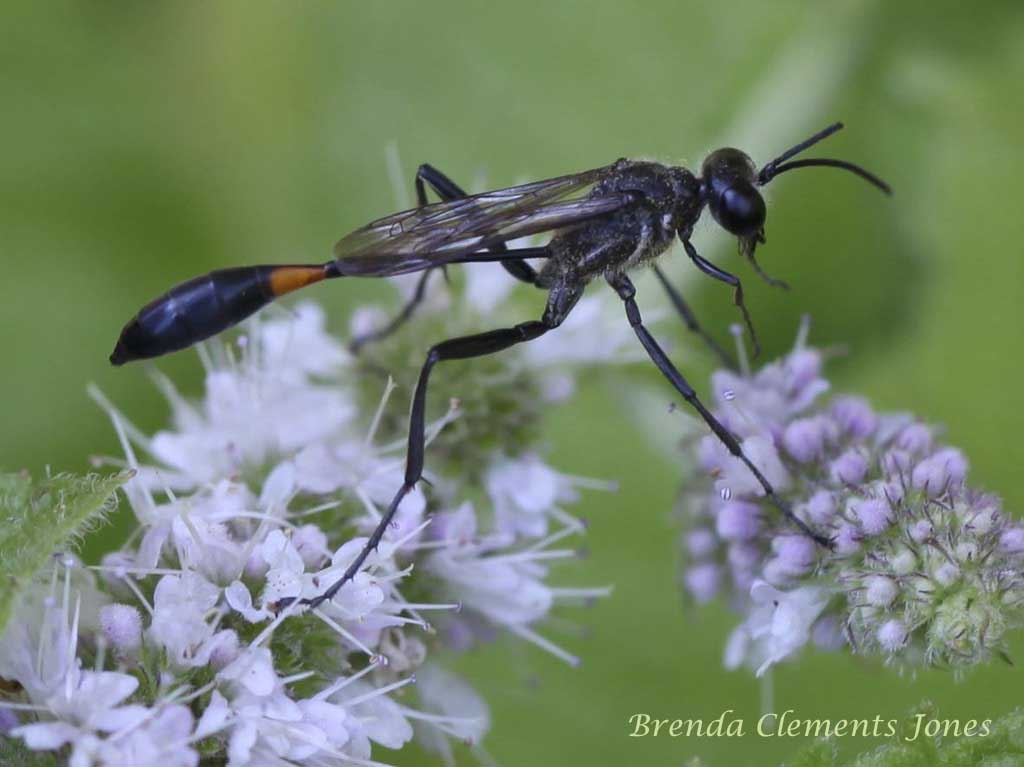
Thread-waisted Wasp (Ammophila procera) showing off its most unusual appearance. Their size ranges from the larger females, 0.8 to 1.4 inches long, to males, 0.6 to 1.2 inches long. Their lifespan as adults is generally, for males 3 to 10 days, for females 2 to 4 weeks, sometimes as long as 6 weeks.
As adults they eat nectar, and in this role, they are beneficial garden pollinators. Their larvae do not eat nectar, but adult females hunt and paralyze various insects and spiders, put them into a nest and lay eggs on them. Once hatched the larvae will eat the meal waiting for them.
These wasps are quite gentle and rarely sting us humans unless they are mistreated by being trapped, handled or stepped on.
_______________________
If you would like to receive my daily blog posts by email, sign up here!