Author Archives: Brenda Clements Jones

About Brenda Clements Jones

Brenda is a certified Virginia Master Naturalist, a Habitat Defender for Shenandoah National Park, and a devoted fan of Mother Nature. She lives in a cabin in the Blue Ridge Mountains near Shenandoah National Park, and hikes up to the higher elevations of her mountain often to see what nature is up to. Her constant hiking companion is a camera that captures nature as it unfolds through the seasons. It’s her goal to share the natural world around her through her photographs.

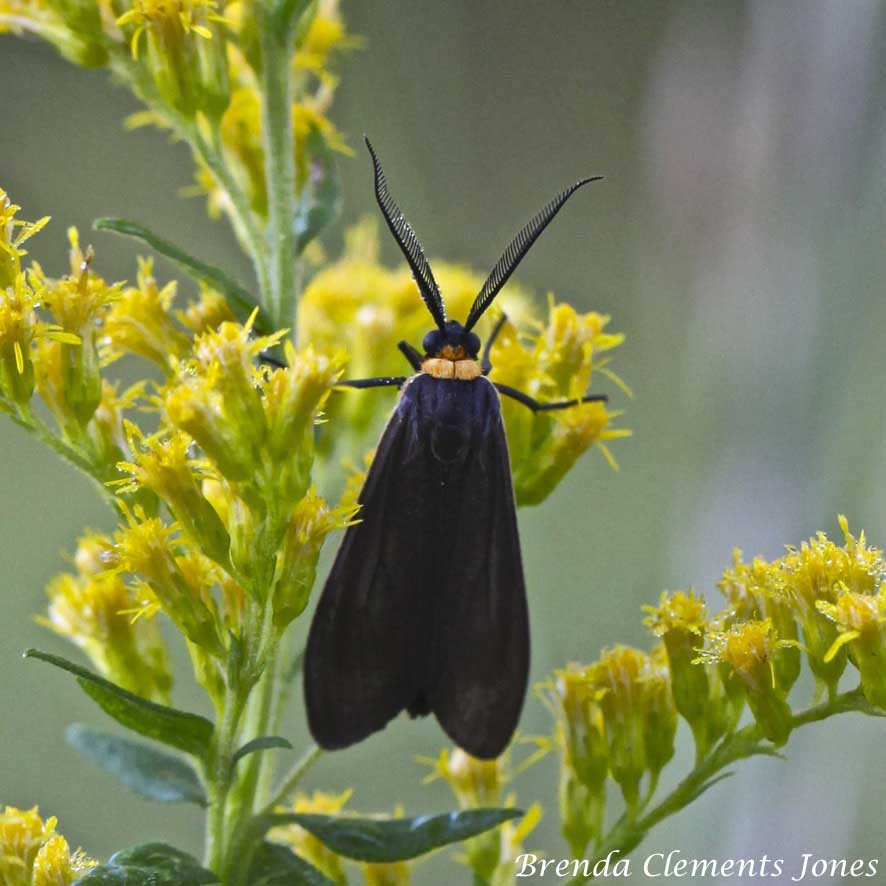
Virginia Creeper Sphinx Moth

July 22, 2026

With a wingspan of 2 to 3 inches, this is a Virginia Creeper Sphinx moth (Darapsa myron). It’s found from Maine, south to southern Florida; west to North Dakota, Nebraska, New Mexico and Texas.

Their caterpillars have a large, creepy look about them, but they are non-venomous and safe to handle if you do that sort of thing. They are an excellent food source for native birds, and are often parasitized by helpful garden wasps. But these caterpillars are a problem for vineyards that are not yet well established, voraciously defoliating the moths’ host plants of wild and cultivated grapes, and Virginia creeper.

As adults they are beneficial pollinators, visiting flowers at dusk and dawn.

And the adults are mighty cool looking.

_______________________

If you would like to receive my daily blog posts by email, sign up here!

A Silvery Checkerspot

July 21, 2026

A little bit bigger than the teeny Hairstreak butterflies that I mentioned in my past two posts, this Silvery Checkerspot (Chlosyne nycteis) has a wingspan ranging from 1 3/8 to 2 inches. They are native to North America, and can be found in the eastern and central United States and further north into southern Canada.

The adults of this species live about 10 to 14 days, while a particularly hardy individual might be able to survive for 3 weeks. During their short life they consume the nectar from many flowers including, red clover, common milkweed, dogbane, and sunflowers such as this Woodland Sunflower (Helianthus divaricatus).

The host plants of the Silvery Checkerspot are two species of Black-eyed Susan (Rudbeckia hirta, and Rudbeckia fulgida), various Sunflowers (Helianthus species), Wingstem (Verbena alternifolia), and various Ragweeds (Ambrosia species).

_______________________

If you would like to receive my daily blog posts by email, sign up here!

Another Of The Hairstreaks

July 20, 2026

Yesterday I did a post about the Gray Hairstreak (Strymon melinus). Today’s Hairstreak is a similar looking, Red-banded Hairstreak (Calycopis cecrops). Small, swift flying butterflies, there are around 100 to 139 species of Hairstreaks in North America.

This butterfly is another small one, with a wingspan of 7/8 to 1 1/4 inches, found in the eastern United States. Most butterfly larvae eat living vegetation, this species has a surprise. Its caterpillars feed for the most part on dead or decaying leaves, mainly of sumac and oak.

Seen today on Apple Mint (Mentha suaveolens).

_______________________

If you would like to receive my daily blog posts by email, sign up here!

A Gray Hairstreak

July 19, 2026

Ventral (wings up) side of the Gray Hairstreak (Strymon melinus). A butterfly with a wide range, from southern Canada all the way down to northern South America. They occupy a large variety of habitats, from tropical forests and mountains, to temperate woodlands and meadows, cities, and farmlands.

Dorsal side (wings open) of the Gray Hairstreak. A tiny butterfly with a wingspan of between 1 and 1 1/4 inches. They have an incredible wide variety of host plants, including mallows and legumes, but many, many, many more.

_______________________

If you would like to receive my daily blog posts by email, sign up here!

Blue Cohosh Berries

July 18, 2026

Though they look like berries, these are actually seeds. Poisonous seeds. Like many plants, all parts of this plant, Blue Cohosh (Caulophyllum thalictroides), are toxic to humans. Even handling the plant can cause skin irritation.

The bright blue of the fleshy seed coats attract woodland birds. The bitter taste of the leaves discourage White-tailed Deer (Odocoileus virginianus) and other mammalian herbivores from eating the leaves and stems.

When I’m out roaming the woods, I’m not out there to eat what I find. I’m out just to take in the enormous amount of beauty there is along all the trails.

_______________________

If you would like to receive my daily blog posts by email, sign up here!

A Juniper Hairstreak

July 17, 2026

Rare creatures around the world. Green in the world of butterflies is one of the scarcest of colors. These greens are created by way of using structural coloration and natural pigments. Wings of the green butterfly are covered with small prism like scales bending and reflecting light, all colors except green get cancelled out. This is structural coloration.

The Juniper Hairstreak (Callophrys gryneus) is one of the very few green butterflies native to Virginia. A tiny butterfly with a wingspan of just one inch. Its single host plant is the Eastern Redcedar (Juniperus virginiana).

_______________________

If you would like to receive my daily blog posts by email, sign up here!
Upside Down

July 16, 2026

The very best of sunflower seeds are the ones that involve getting into an upside down position in order to obtain them. This, a Goldfinch (Spinus tristis) demonstrating.

_______________________

If you would like to receive my daily blog posts by email, sign up here!

A Tiger Swallowtail

July 15, 2026

An Eastern Tiger Swallowtail Tiger Swallowtail (Papilio glaucus) sipping sugary, energy-rich nectar from Purple Coneflowers (Echinacea purpurea).

It’s marvelous to have so many native plants in bloom, attracting multitudes of pollinators!

_______________________

If you would like to receive my daily blog posts by email, sign up here!

Buckeye

A Common Buckeye (Junonia coenia), a butterfly that I don’t see in early summer. I adore seeing them in mid to late summer, once they show up.

These lovely butterflies are migratory, and are unable to survive freezing temperatures. They stay safe in the Deep South during the cold of winter, migrating north during late spring and early summer.

This one is enjoying the nectar of Apple Mint (Mentha suaveolens).

_______________________

If you would like to receive my daily blog posts by email, sign up here!

Two-spotted Bumblebee

July 13, 2026

The Two-spotted Bumblebee (Bombus bimaculatus) atop a Purple Cone Flower (Echinacea purpurea), looking a bit like a cuddly stuffed animal. Its name comes from the two yellow spots at the top of its abdomen.

For this Bumblebee, nectar is a source of carbohydrates and energy, and the protein rich pollen is brought back to their nests for the developing larvae.

Their nests are usually built in abandoned animal burrows, or in hollow logs and brush piles. The nests that are underground are typically 6 inches to 12 feet underground with long entry tunnels, and can be difficult to spot. If you find one near your home, consider that these bees are gentle and highly beneficial pollinators for your garden and fruit trees.

_______________________

If you would like to receive my daily blog posts by email, sign up here!