Sassafras

You know the question, If you were a tree, what tree would you be? My quick answer would be, a sassafras tree. I’ve had a cabin in the Blue Ridge Mountains, in Virginia, since 1992. During that time I’ve hiked my mountain up and down, getting to know all the things that grow here. I love them all, but the sassafras speaks to me. Speaks to me more than any other tree.

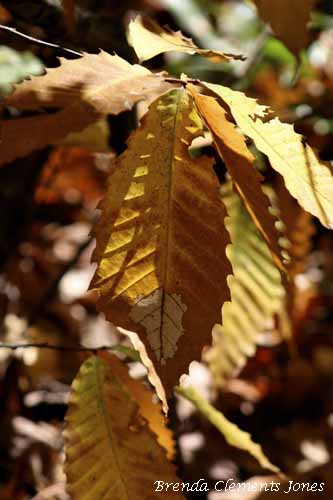
I’ll introduce you to the sassafras trees that I know here on the mountain. I’ll start with this season. Autumn. I am a color person. Color is extremely important to me. The sassafras celebrates autumn with splendid colors. Its rich green leaves, fading into lime green, butter yellow, school bus yellow, as the chlorophyll in its leaves fades away.

But that is just the beginning. The sassafras becomes a multicolored fiesta in autumn. Rust red, burgundy and many a shade of orange appear.

These leaves, like the twigs, bark and roots, all have the fragrance of root beer. Perfect timing: as I write this, my husband brings me an icy mug of root beer. Mmm! It takes me back to my childhood.

As I reminisce, I recall that sassafras oil has been determined to contain a carcinogenic substance, safrole. Root beer no longer contains safrole. You would be wise not to dig the roots of sassafras, to use as a root beer flavoring, or to make tea, as I did as a child. That lovely aroma, sure brings the memories back. But let’s be safe.

As the leaves fall, the intricate texture of the bark becomes my focus. And the color of the bark, just below the surface. A rich, cinnamon red-brown. Looking, just the right color, to match that childhood memories aroma. The bark, a lovely lacework of ridges, undulating this way and that.

And, like the bark, the trunks of the sassafras trees appear to dance through the forest. Like the bark pattern, bending this way and that. Winter is a favorite season for me. It reveals the trees’ structure. The trees’ form. Sassafras trees bend and sway, even in standing still.

Time flies and the sassafras trees’ buds are waiting for the first of the slightly warm days. At the beginning of April, they begin swelling and by the third week of April, here on Snow Mountain, the woods are filled with flowers.

Not much for show, but still beautiful to me. There is a soft, butter yellow haze in the woods. The flowers arrive before the leaves.

Now I am going to tell you a secret. As fond of sassafras, as I am, I had never seen sassafras drupes (one seeded fruit), until this summer. On finding some, I was amazed at their unusual look. Patriotic red and blue.

And yet, I understood why I had not seen them before. The leaves provide a perfect hiding place for the drupes. So much so, that it was a challenge to get a photograph to show you.

The drupes are popular with many birds and once they are gone, their receptacles are still attractive. Crimson against the green leaves.

Lovely sassafras has a weakness, if you are going to plant a few in your garden. If you are in an area prone to problems with Japanese Beetles, beware. Japanese Beetles really enjoy Sassafras leaves. Fortunately for me, my woods are my gardens. They are filled with Sassafras. A Japanese Beetle chomped away on this leaf, but there are still many, many more untouched.

But with that attractiveness to Japanese Beetles, it certainly has its strengths as well. Another critter that eats the sassafras leaf, is the caterpillar of Eastern Tiger Swallowtail. I consider that a big plus. Along with its beauty, it tolerates clay soils, and drought. Deer, and gypsy moth caterpillars will go for other things to eat, before they chomp on sassafras.

Once I became acquainted with the trees on the mountain, I realized that sassafras trees can grow to be quite large. Up to about 60 feet in height. They are most often seen as the understory shrub though.

Allelopathic is a term used to describe a characteristic of sassafras. That means the tree releases a chemical that hinders the health of some plants living around the sassafras. American elm is one of the trees that is affected by this chemical. This is a defense for the sassafras, eliminating some of its competition.

I am very fortunate being here in the woods. Sassafras trees come up as volunteers all over. I love it!

Wood Poppy

woodpoppy1

Brilliant color. A sure hit in my garden. Add the fact that the brilliant color is a native to moist woods, of eastern North America, and it becomes a must have for me. A must have for my garden.

woodpoppy2

This screaming yellow bloom is of Wood Poppy, or Celadine Poppy,  Stylophorum diphyllum.

woodpoppy bud

The Wood Poppy shows hints of bloom as a fuzzy bud. It begins blooming in my garden (which is at an elevation of 1,800 feet in the Blue Ridge Mountains, of Virginia) in mid April. The plants continue blooming for a couple months.

woodpoppy turning leaves

The leaf of Wood Poppy reminds me of a White Oak leaf. Deep sinuses. As mid summer arrives, the leaves begin to change color. Just a slight change of color. A hint of autumn to come.

woodpoppy wet leaf

The seeds have a way of putting plants in odd places. If you have a neat, tidy garden with regimenation, unlike mine, you’ll want to give the new plants guidance in placement. The plant is most happy in a moist location, in shade or part shade.

Even now, as August weather is hinting at fall, I am enjoying the Wood Poppies in my garden. I particularly enjoy them at this time of year, when there is rain. The rain drops on their leaves are beautiful.


Smooth Sumac

Just a couple weeks ago, some of the bushes along my woodland edges were abuzz with pollinator activity. The flowers of Smooth Sumac, Rhus glabra, were the magnet.

Butterflies, including this Red-banded Hairstreak, Calycopis cecrops, were part of the crowd.

Honey Bees, gathering nectar, to help some bee keeper with his honey supply were also attracted. And so many other insects. Sweat bees, wasps. Too many to identify or list here! Believe me, Abuzz!

Smooth Sumac is a dioecious plant, meaning that male and female flowers appear on separate bushes.

There are many references to a lemonade being made from the berries. Call me chicken, but I’m not going to experiment, particularly because I am allergic to nuts and the thought that this shrub is in the cashew family (Anacardiaceae) is warning enough for me.

Autumn brings scarlet to the sawtooth edged leaves.

The bushes form dense colonies, by means of root suckers, and are easily spotted along the roadsides in many areas, in the fall, thanks to the brilliant red foliage.

The berries are an emergency food for many, many song birds through the winter.

This Yellow-shafted Flicker, or Northern Flicker, Colaptes auratus, is glad to have the emergency supply. I took this photograph during a heavy snow, back in February, 2010.

And as the seasons roll along, winter turns to spring. The compound leaves sprout, looking like ferns as they unfold. And the whole cycle repeats itself.

Pink Fog

Perhaps spring is here. Though the forecast for this coming Tuesday (the day this will be published) is for more snow.

My Redbuds, Cercis canadensis, here in the mountains of central Virginia are just now showing the slightest signs, of thoughts of blooms. This picture, above, was taken 5 days ago, while our newest, 8 inches of snow, were still festooning tree branches. Buds with just a hint of swelling.

In what will seem like, less time than the blink of an eye, my Redbuds will be sprouting their pinkish-purple blossoms. Sprouting blossoms that will be pollinated by long-tongued bees. Sprouting from buds along its zigzag branches, and sometimes even from the trunk of the tree itself.

The trunk, with its sprouting buds, is often twisted, looking as if it is participating in a yoga class.

To my eyes, which are even now, just awakening from a black and white, monotoned winter, the color will be dazzling! Along with tiny bits of apple green, there will be a flooding of the softest of magenta, in the just coming alive forest. It will appear to be a pink watercolor wash, over nearly everything.

At this point in the emergence of spring, on rare occasions, an event might happen if I am lucky. Pink Fog. The right temperatures, the right humidity and the sun doing its best to filter through all the Redbud blooms and PRESTO! Pink Fog! Beautiful!

For about one week, during this unfurling of spring, there will be an overlapping of blooms. Redbuds on the decline, and another native tree, the Flowering Dogwood, Cornus florida, just coming into bloom, contrasting their pink, and bright, snow white petals.

While the forests are having their pink and white dance, the Redbud flowers will be aging. Redbud leaves will be pushing their way out into the world. Leaves blushed with red that are perhaps the inspiration for the name Redbud. Leaves that have filled my photo collection, of Mother Nature’s hearts. Leaves that will provide food for caterpillars, of butterflies and moths of the forest, such as the striking Io Moth, Automeris io.

The seasons march on. The distinctive fruit of the Redbud will develop into flat, pea-like pods that contain 10 to 12 seeds.

As those seed pods develop, the Redbud leaves will be turning a brilliant yellow, preparing the trees for winter.

But back to the present and maybe spring. No Redbud blooms yet. Here’s to spring really happening. Here’s to at least one Pink Fog event!

Poison Ivy Good?

I am highly allergic to Poison Ivy (Toxicodendron radicans). As a youngster, I never got a Poison Ivy rash, though I loved to romp in the unending woods directly behind my house. Vines to swing over the creek, forts my friends and I were out there constantly. In 1985 I had a wakeup call, with an extremely painful rash on my arm. My luck had run out. A trip to the doctor’s office got me temporary relief with steroids. I have a quilt to show for the time I was on those steroids and bouncing off the walls. I resorted to creating a quilt to help my addled brain. I quickly learned to avoid at all costs the beautiful plant.

Beautiful Plant?

Yes, I think Poison Ivy is quite a beautiful plant. Just look at its scarlet leaves in the first photograph. This is the scarlet of spring, with leaves that are often very shiny, whether scarlet in spring, or green in summer. As spring turns to summer, the plant puts out flowers. Large clusters of soft, pale green, with brilliant school bus yellow centers.

More Color In Autumn

As trees are putting on their autumnal show, Poison Ivy whether in its vine form, climbing way up into trees, or trailing along the ground, or taking on the form of a small bush, puts on its own show with bright color. Either sunshine yellow, crimson red, or pumpkin orange.

Sculpture

The vines, creeping up tall trees, only know sky as the limit. They climb as high as a tree will grow, with their thread-like hairs. The vines make me think of sculptures, wrapped up and around lovely textured bark. Those thread-like hairs of the Poison Ivy vine, can sometimes be found in the nests of cardinals and goldfinches. A helpful building material.

Berries

As the autumn leaves fall, they leave behind berries. Off white berries, speckled with a bit of bitter chocolate brown. These berries attract many birds. Bluebirds, crows, turkeys and all manner of woodpeckers.

The wonderful winter of 2009–10 which covered the ground here on my mountain with 72 inches of snow, created a Poison Ivy fruit cafeteria of berries for a remarkable number of woodpeckers. Many pileateds, and yellow-shafted flickers descended upon a large oak tree covered with Poison Ivy in front of my cabin. They returned day after day, until the many vines were stripped of their berries. That winter gave me new respect for what Poison Ivy can do for birds in my area.

Diamonds Of Ice!

Redosier Dogwood, Cornus sericea, berry stems
Redosier Dogwood, Cornus sericea, berry stems, on main stem of deep red.


As I snuggled in my bed last night, I was prepared for nothing special in the weather this morning. Yesterday‘s forecast had been for snow, sleet and freezing rain.

Flowering Dogwood, Cornus florida
Flowering Dogwood, Cornus florida, in bud, patiently waiting for spring, in soft green and muted red.


Mother Nature skipped the snow part, and went straight to sleet, and it kept going, all day long. The temperature remained steady at 27 degrees during the whole day, but as bedtime drew nigh, it began to rise quickly and by the time I went to bed it was 32 degrees with no signs of leveling off. So my thoughts of a beautiful morning were of a beautiful rainy, wet morning.

Blue Spruce, Picea pungens, and this year's Christmas tree
Blue Spruce, Picea pungens, and this year’s Christmas tree, in lovely pale blue-green.


The little girl within me was more than delighted this morning as daylight revealed a thick coating of ice over everything!

Winterberry, and one of my goals accomplished with a wintery photo of this beautiful shrub!
Winterberry, and one of my goals accomplished, with a wintery photo of this beautiful shrub.  Complete with scarlet berries and white diamond ice!


I very quickly put breakfast on the table for the family, gobbled mine down, and went out into the wonderland of diamonds and ice.

The very sharp end to a Yucca leaf, complete with ice
The very sharp end to a bluish green Yucca  leaf, edged in golden yellow, complete with ice.


Thank goodness I have trekking poles!  The ice was thick and not forgiving for a false move, and to further complicate things, I’m on the side of a mountain! Every surface is on a slant. With the poles though, I didn’t take a spill.

Virginia Pine, Pinus virginiana
Virginia Pine, Pinus virginiana, like green flowers.


When I left the cabin, the temperature was 32 degrees and it was very cloudy.

Grape Vine Tendrils
Grape Vine Tendrils. showing a bronzy glow.


There was no dripping. Everything in a frozen, fairlyland.

Blueberry Bushes, with their buds all set for spring
Blueberry Bushes, with a blush of Christmas red, with their buds all set for spring.


As I returned to my cabin, the sun was just beginning to break through the clouds, and like magic, it seemed to begin raining. Of course it wasn’t rain, but melting ice, dripping down on me.

Seed Head of Queen Anne's Lace
A tan Seed Head of Queen Anne’s Lace.


Now this afternoon most of the diamonds and ice are gone from the trees and bushes.

Smooth Sumac, Rhus glabra
Crimson, Smooth Sumac Berries, Rhus glabra.


But no worries! There is snow in tomorrow’s forecast!

Like A Pinecone Dipped In Molten Glass
Like A Maroon Pinecone Dipped In Molten Glass.


How cool is that?

Seed Head Of Echinachea purpurea
A Toast-brown Seed Head Of Echinachea purpurea.


Stay tuned!  I may be in my element tomorrow again, wandering with my hiking companions, my two cameras, taking snow pictures!

Seed Head Of Tall Anemone, Anemone virginiana
Soft Butter-yellow and Toast-Brown Seed Head Of Tall Anemone, Anemone virginiana.


Red Maple Common Beauty

Red Maple Leaves, Acer rubrum

Ubiquitous

This fall, as I hike the steep and not so steep slopes of the Blue Ridge Mountains, I see many, many Red Maples. Reading various websites and books to get information on the tree, I am not surprised to learn that this is the most common deciduous tree in eastern North America. Yes, it is everywhere. Red Maples do well, for the most part, no matter what conditions they are asked to deal with. They will live in swamps and can easily be found on dry ridges. Soil type is not something that the tree quibbles about either.

Red Maple Blooms In Late February

Early Bloomer

Red Maple is the earliest flower you’ll see here in the Blue Ridge Mountains. Even beating out the first of the Bloodroot.

Caught In The Snow Of Late March

Deep, Rich Red In The Snow

They bloom so early that often you will find their wine colored flowers covered in snow.

Samaras Of The Red Maple

Leafless

Before the leaves appear, the flowers of the Red Maple turn to samaras, or as I called them as a child, helicopters. The seeds that will sprout new trees. Notice, that like the flowers of this tree, the samaras are also reflecting the name of this maple, Red.

Tiny Red Maple Leaves

Still More Red

Soon after the samaras show up on the branches of the Red Maples, leaves start to emerge, and being true to its name the emerging leaves are red.

Young Red Maple Leaves

Not True

Of course not all the young Red Maple leaves are a true red, but are subtle shades of red.

The Bark Of Young Red Maples

Silvery

The bark of young Red Maple trees is a distinctive, smooth silver gray.

An Older Red Maple With Cracked Charcoal Gray Bark

Charcoal

As the tree ages the bark develops cracks and becomes a darker, charcoal gray.

Color In Fall

Autumn

As the seasons roll on, Red Maples are an independent sort and don’t rely on their name for the color that their leaves turn in the fall. You will find Red Maple leaves in pumpkin oranges, lemon yellows, crimson reds and every color and shade in between. This fall the Red Maples have been beautiful and have provided me with loads of joy, and much new knowledge. I hope your autumn is unfolding before you in a totally pleasing way!

Swirls Of Color, Yellow to Red, All Red Maple


The Comeback of American Chestnuts?

Chinese chestnut is a being used as a source of resistance for the American chestnut tree. This picture: monarch butterfly on Chinese chestnut flowers.

Stories From Long Ago

You might be fortunate enough to have family accounts from the older generation of gathering chestnuts, or of your granddad building a fence from chestnut trees on his farm. I don’t have those stories in my family traditions, but still I fell in love with the American chestnut tree when I heard of its history.

American chestnut burs typically have up to 3 seeds. If you’re going to handle them, it’s suggested you use leather gloves!

So Many Trees

Before 1900, the American chestnut tree (Castanea dentate) made up approximately one quarter of the trees in its range, an area of two hundred million acres. Its native range extended from Maine and Ontario, south to Florida and Alabama, and northwest through Indiana and Illinois.  The tree had lived in this area for thousands of years.

The American chestnut tree was large in the forest. Historically it grew to 100 feet tall and 10 feet in diameter. This American chestnut snag was found in Madison County, Virginia.

So Quickly Gone

Late in the 1890s, as Americans began to import chestnut trees from Asia and Europe, the chestnut blight (Cryphonectria parasitica) was accidentally brought with them.  The Asian and European trees had lived and evolved with this fungus for generations, but it was new and deadly to the American chestnut.  The blight was an airborne fungus introduced to the trees through any number of otherwise small injuries.  It spread rapidly and within 50 years of the blight’s introduction it wiped out up to three billion American chestnut trees.

The delicious American chestnut is an excellent source of vitamins, minerals and is low in fat.

Important To The Economy of Appalachia

The American chestnut was an important crop in the Appalachian Mountains.  It had a superior taste compared to the Asian and European chestnut and there was great demand for it. The nuts provided a great source of income for the people of these mountains, who also fattened their cattle and hogs on the nuts under the chestnut trees.  It was an important tree for wildlife, the nuts providing a reliable food for deer, black bear, and wild turkey. The tree was a valuable hardwood timber tree. It was easy to work with and highly resistant to decay. The tannins in the bark of the tree were also used to tan leather.


I was thrilled to find some small American chestnut trees growing on the mountain where I live, in central Virginia.

There Are Still A Few Around

Today in the forests of the Blue Ridge Mountains, and all over the native range of the American chestnut, every now and then you will find a small cluster of little American chestnuts trying to survive.  You might think of these trees as American chestnut “bushes”.  They will not grow tall and proud as the trees once did.  The blight does not kill the roots, so the trees keep sending up new growth.  A new sprout will shoot up, grow for a few years and die thanks to the chestnut blight that has attacked so many of these trees.


Volunteers planting American chestnut seeds at the Virginia Department of Forestry.

Hard At Work to Bring Back This Treasure

Scientists and volunteers working with The American Chestnut Foundation have been crossing American and Chinese chestnut trees then backcrossing the offspring with other American chestnuts in an attempt to develop a tree with the traits of an American and the blight resistance of a Chinese chestnut tree. There is great hope that this goal has been reached but much more research needs to be done.  Only time will tell.  Check back in 100 years or more.

An American chestnut seedling which is planted with great hope for the future of our forests.